“Our experience with Urge was a complete transformation. From day one they were fully engaged, from revamping our website to social content, they delivered at every turn.”
Services · Local SEO
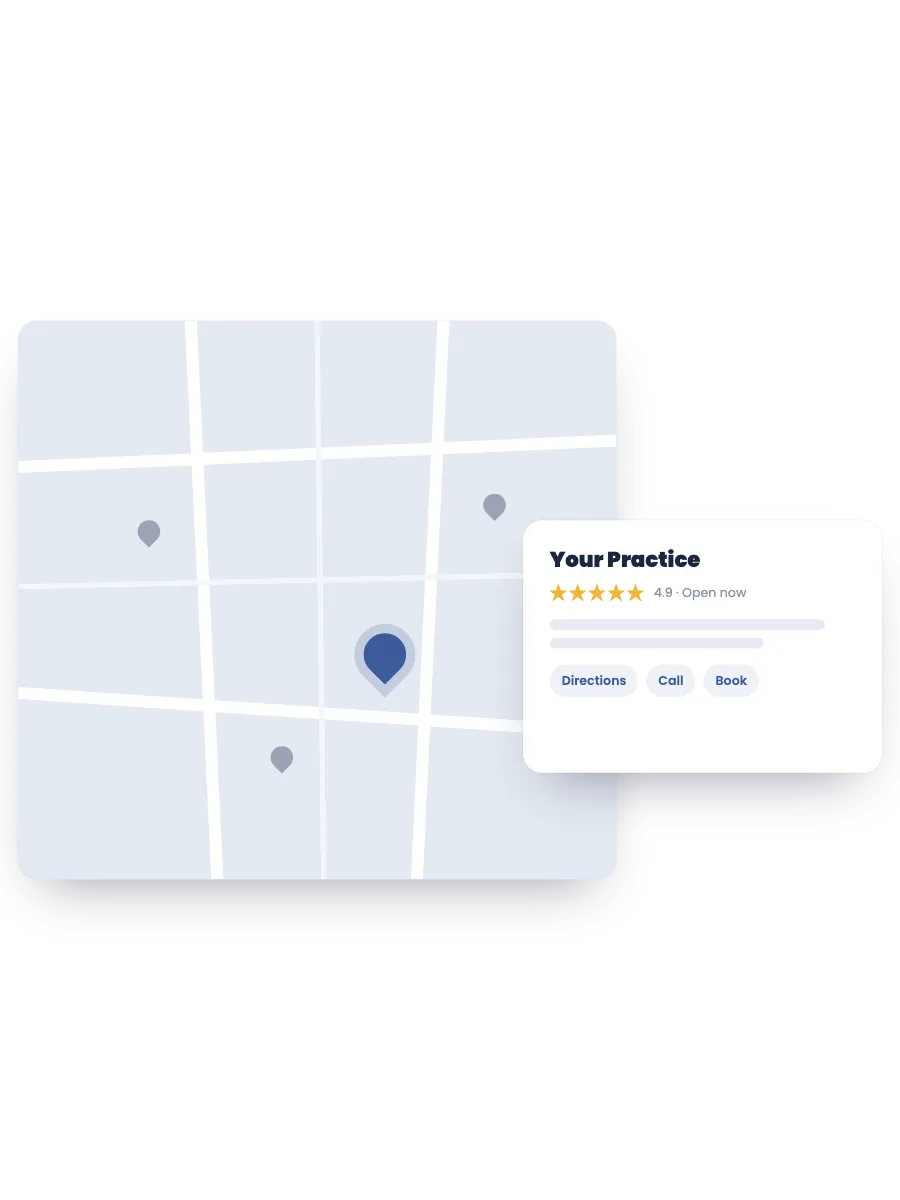
Local SEO and Google Business Profile That Put Your Practice on the Map
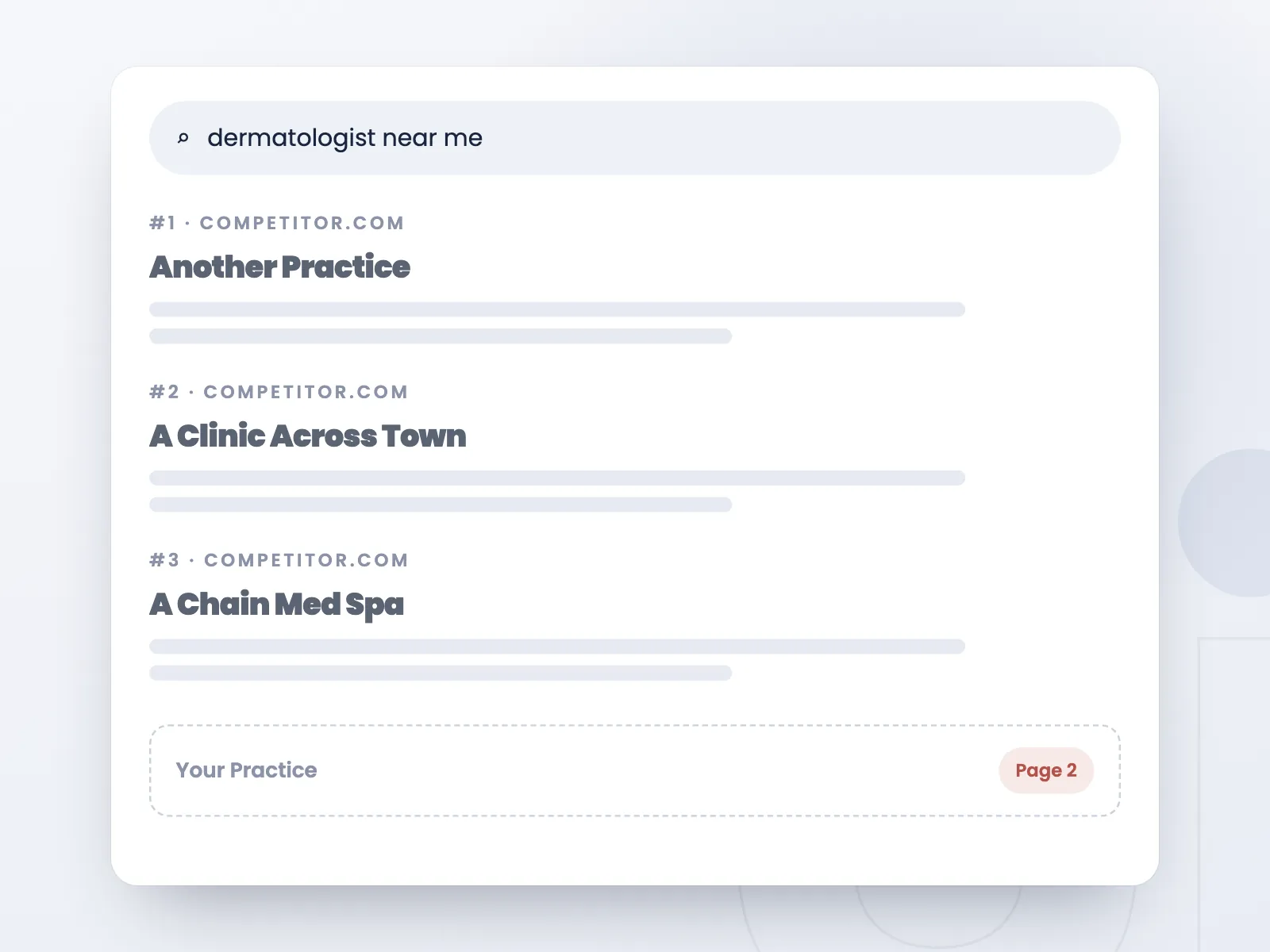
When someone nearby searches "best practice near me," you want to be the answer. And now you want to be the answer the AI gives, too.
When a patient nearby searches for what you do, you have one job: be the practice they find first, on Google, on Maps, and now in the AI answer. We make sure you are.
- On Google, Maps, and AI
- Every location, done right
- A built-in review engine
- Built on Urge Foundation
OVERVIEW
Local SEO is the practice of getting a business found by nearby customers in Google Search, Google Maps, and AI answers. For medical and aesthetic practices it centers on an accurate, optimized Google Business Profile, consistent business information across the web, strong reviews, and locally relevant pages. According to Google, 46% of searches have local intent, and 76% of nearby searches end in a visit within a day.
Why it matters now
Why local search decides who fills the schedule
Nearly half of all Google searches have local intent, and 76% of people who run a nearby search visit a business within 24 hours, according to Google.[1] A complete Google Business Profile makes a patient 2.7 times more likely to see your practice as reputable and 70% more likely to visit, again per Google’s own data.[1] This is not a slow, someday channel. It is patients deciding, today, which nearby practice to call.
-
46% of searches are local. Nearly half of all Google searches carry local intent, and those patients are deciding which nearby practice to call right now.
-
76% visit within 24 hours. Most people who run a nearby search visit a business within a day, according to Google. This is a today channel, not a someday one.
-
Your profile now feeds the AI. Your Google Business Profile is the primary data source feeding Google’s AI across Search, Maps, and Gemini, so the same profile that ranks you is what the AI reads.
-
45% now ask AI for local picks. 45% of consumers now use AI tools for local recommendations, up from around 6% a year earlier, and showing up there is roughly 30 times harder than ranking in normal local results.
Here is what changed
Here is what changed. Your Google Business Profile is now the primary data source feeding Google’s AI across Search, Maps, and Gemini, so the same profile that ranks you in the map pack is what the AI reads when a patient asks it to recommend a provider. And patients are asking: 45% of consumers now use AI tools for local recommendations, up from around 6% a year earlier.[2] Showing up in those AI answers is roughly 30 times harder than ranking in normal local results,[3] and the practices that get cited are the ones whose information is accurate everywhere AI looks.
Your Google Business Profile is the most valuable real estate in local search
It is free, it is where patients decide, and most practices barely use a third of it. We optimize all of it: verification, every field completed, the right primary and secondary categories, real photos, regular posts, a seeded Q&A, accurate hours including holidays, attributes, and a steady flow of reviews with timely responses. Google’s own data is blunt about the payoff: complete, active profiles get found, considered, and visited far more than neglected ones.[1]
Multiple locations? That's where local SEO gets hard, and where most practices lose ground
If you run more than one office, you do not have one local SEO problem, you have one per location, plus the job of keeping them all consistent. Get it wrong and your strongest location can quietly cannibalize your weakest, or Google hedges and shows a competitor instead. Here is how it is actually done, per Google’s own guidelines:
- Every location gets its own verified Google Business Profile. Google treats each office as a separate entity. One shared profile only ranks for one area and leaves your other locations invisible on Maps.
- A unique local phone number per location. A single central number across all offices confuses Google’s verification and can get profiles flagged. A local number per office, even if it forwards to one front desk, is the correct setup.
- A dedicated, genuinely unique page per location. Not the same page with the city name swapped, Google detects templated duplicates and ignores them. Each location page gets its own services, local detail, local FAQs, embedded map, and
LocalBusinessschema. - NAP consistency at scale. Your name, address, and phone must match character-for-character everywhere. “Suite 5,” “Ste 5,” and “#5” read as three different addresses to Google.
- Reviews managed per location. Recency and steadiness matter as much as the total: a location with a steady trickle of fresh reviews can outrank one sitting on a big pile of old ones.
- At ten or more locations, Google’s bulk verification and business groups let us manage the whole footprint without sacrificing per-location accuracy.
This is exactly the kind of complexity that overwhelms an in-house team and quietly drains rankings. It is also the kind we have been untangling for practices for two decades.
Reviews are no longer optional, they're the engine
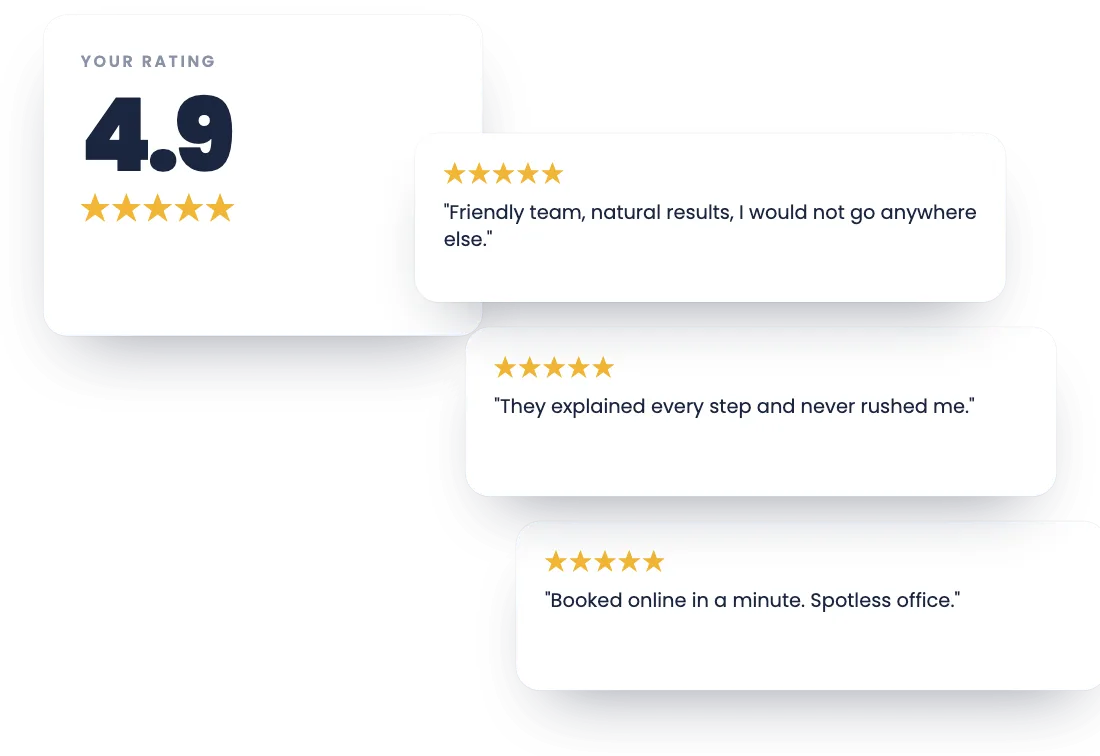
87% of consumers read reviews before choosing a local practice,[2] and reviews are now one of the strongest local ranking signals there is. But the practices that win at reviews are not the ones that occasionally ask, they are the ones with a process. So we build one in. Urge Foundation™ includes a built-in review process that makes it easy to invite happy patients to leave a review at the right moment, so it happens consistently instead of whenever someone remembers. Then we make sure every review gets a timely, on-brand response, because responding is itself a ranking and trust signal.
When reputation needs deeper work, monitoring across platforms, recovering from a rough patch, or a full strategy, that is where our Reputation Management service takes over. Local SEO gets the review engine running; reputation management is the full operation.
The HIPAA trap in review replies that quietly fines practices
Here is one almost every generic agency gets wrong, and it has cost real practices real money. When you reply to a patient’s review, you cannot confirm they are a patient or acknowledge the treatment they mention, even if they named the procedure themselves in the review. Under HIPAA, even confirming that someone is your patient discloses protected health information, and the HHS Office for Civil Rights has fined practices tens of thousands of dollars for doing exactly this in public review responses. So replies stay general: thank people warmly, never confirm care or a procedure, and move any specifics to a private channel, like “we’d love to talk, please give our office a call.” We write every response with this in mind, because it’s privacy-first, and because it keeps you out of trouble.
One wrong phone number can cost you patients you'll never know about
NAP is your Name, Address, and Phone, and search engines use it to confirm your practice is real and where you say it is. When it conflicts across the web, Google hedges and AI engines do worse: only about 68% of business contact information on ChatGPT and Gemini actually matches the Google Business Profile,[3] which means a third of the time the AI is working from stale or wrong data. We pick one canonical format and make it consistent everywhere Google and the AI engines look, so they cite you with confidence instead of recommending the practice down the street whose data is cleaner.
For a medical practice, the right directories are a different game
General directories like Yelp and the old Yellow Pages still count, but for a medical or aesthetic practice the listings that move the needle are the industry-specific ones, and Google leans on them to confirm you are a real practice with licensed, legitimate providers. The ones that matter:
- Healthgrades and Vitals: two of the largest medical directories. Google reads them to validate your providers’ credentials and confirm your practice is a legitimate medical entity.
- WebMD: one of the most-visited health platforms, and where many patients go to find a local specialist.
- RealSelf: the one that’s crucial for aesthetic practices. It’s where patients research cosmetic procedures, read procedure-specific reviews, and look for verified local injectors and surgeons before they ever open Google. For a MedSpa, dermatology, or plastic surgery practice, a strong RealSelf presence is its own decision point.
We make sure your practice is listed and consistent across the directories that matter for your specialty, and Urge Foundation™ can support the links back to those profiles so they reinforce each other. Getting this right is also a core E-E-A-T signal, the experience, expertise, authoritativeness, and trust that Google demands of medical (YMYL) sites.
Patients find you in more places than Google Maps
People navigate from their phones, their cars, and their voice assistants, and your practice should be visible across that whole ecosystem, not just Google and Apple Maps:
- Waze (owned by Google) shows up on the dashboards of countless vehicles and is where commuters look. You can add and optimize your location so drivers physically see you on their daily route.
- Bing Places is Microsoft’s free listing platform, feeding Bing, Windows, and the wider voice-and-assistant ecosystem. It’s quick to claim and easy to overlook.
- HERE is the mapping platform behind the built-in navigation in vehicles from automakers like Audi, BMW, and Mercedes, which co-own it. You can submit your practice directly through its map creator so it shows up in those in-car systems.
It’s the unglamorous, thorough kind of work that quietly widens how many patients can find their way to you. We handle it so your practice shows up wherever someone is trying to get to you.
Local SEO is now how you show up in AI
Everything above feeds the AI. An accurate, complete profile, consistent data, strong reviews, and structured, locally relevant content are the same signals that get a practice surfaced when a patient asks Gemini or ChatGPT for a recommendation. The bar is higher (AI local visibility is roughly 30x harder to earn than a normal local ranking),[3] but the work is the work we already do, done to a standard built for AI. That is the difference between a practice that AI recommends and one it has never heard of.
The full discipline
Local SEO is three jobs, done together
Technical: the foundation Google and AI can actually read. This is where Urge Foundation™, our proprietary platform, does the heavy lifting. Every page carries LocalBusiness structured data so Google and AI engines understand exactly who you are, where you are, and what you offer. Fast load times, mobile-first design, clean crawlable structure, and an /llms.txt feed built for AI engines mean your practice is legible to the systems that decide local visibility. Most practice websites quietly fail here. Foundation is built so yours doesn’t.
On-page: pages that earn local relevance. Location and service pages with genuinely local, useful content, geographic relevance done naturally, internal linking that connects it all, and location-specific FAQs that answer the questions real patients in your area actually ask. This is also what makes a page citable by AI. Broad organic work beyond local lives on our SEO service, and the AI overlap on AI Search Optimization.
Off-page: the trust signals beyond your site. Consistent business information across the web (more on that below), reviews, locally relevant links, and clean data in the directories and aggregators that feed Google and the AI engines. Off your site, but decisive for your rankings.
Technical
LocalBusiness structured data, speed, mobile-first design, clean crawlable structure, and an /llms.txt feed, the backbone Google and AI engines can actually read. Built on Urge Foundation.
On-page
Location and service pages with genuinely local, useful content, natural geographic relevance, internal linking, and location-specific FAQs, the pages that earn local relevance and get cited by AI.
Off-page
Consistent business information across the web, reviews, locally relevant links, and clean data in the directories and aggregators that feed Google and the AI engines.
Addressing the real concerns
"I already claimed my Google Business Profile. Isn't that enough?"
Claiming it is step one of about thirty. A claimed-but-thin profile gets badly outperformed by a complete, active one, Google’s own data shows a complete profile makes patients far more likely to consider and visit. The gap between claimed and optimized is where most of your local visibility is hiding.
"We have several locations and it's chaos."
That is the most common and most fixable local SEO problem we see. Each location needs its own verified profile, its own local number, its own genuinely unique page, and consistent data across the web, managed centrally so nothing drifts. It is operationally heavy, which is exactly why it is worth handing off.
"My profile keeps getting suspended or my info changes on its own."
Usually a sign of a data or guidelines issue, an inconsistent address, a category problem, a flagged edit, or a third-party source feeding Google bad information. We diagnose the cause, clean it up, and harden the profile so it stops happening.
"Is local SEO really better than just running ads?"
They do different jobs. Ads buy visibility now and stop the moment you stop paying. Local SEO compounds, the rankings, reviews, and authority you build keep working and keep getting cheaper per patient over time. The strongest practices do both; local SEO is the asset, ads are the accelerator.
What's included
Everything your practice needs to win local
One accountable team running the full discipline, across every location, instead of piecing it together yourself.
Google Business Profile optimization
Verification, every field completed, the right categories, real photos, regular posts, a seeded Q&A, accurate hours, and attributes, all of it, not a third of it.
Multi-location management
A verified profile, a unique local number, and a genuinely unique location page per office, kept consistent across the web and managed centrally so nothing drifts.
A built-in review engine
Urge Foundation’s built-in review process invites happy patients at the right moment, and we respond to every review on your behalf, promptly and on-brand.
NAP consistency at scale
One canonical name, address, and phone format made consistent everywhere Google and the AI engines look, so they cite you with confidence.
Directories that matter for your specialty
Listed and consistent on Healthgrades, Vitals, WebMD, and RealSelf, the industry directories Google leans on to confirm a legitimate medical practice.
AI and GEO visibility
The same accurate profile, consistent data, and structured local content, done to a standard built for the AI engines that now recommend practices.
Why Urge
We do the boring, relentless work that actually wins local
The discipline to win local.
Local SEO is not won with one clever move. It is won by doing the unglamorous things consistently, across every location, month after month, while the algorithm and Google’s own products keep shifting underneath you.
Two decades in medical + aesthetic.
We have marketed medical and aesthetic practices since 2003, and we keep up with every change so you do not have to.
Built on Urge Foundation.
We run it on Urge Foundation, a platform built from the ground up for exactly this, the LocalBusiness schema, speed, structured data, the built-in review process, and the /llms.txt feed that makes you legible to AI.
Done across more practices than you'll need.
You get the discipline of a team that has done it across more practices and more locations than you will ever need to.
46
%
of searches are local
Nearly half of all Google searches carry local intent. [1]
76
%
visit within 24 hours
Most nearby searches end in a visit within a day. [1]
2.7
×
more reputable with a complete profile
And 70% more likely to visit, per Google. [1]
2003
winning local for practices since
20+ years in medical + aesthetic.
How it works
From audit to map pack
Audit
We baseline your local visibility, your Google Business Profile, your NAP across the web, your reviews, and how AI engines see you today.
Optimize
We complete and harden every profile, fix NAP everywhere, and clean up the directories that matter for your specialty.
Build
Genuinely unique location and service pages with local content, schema, and the technical backbone on Urge Foundation.
Manage
The review engine runs, reviews get timely on-brand responses, and every location stays consistent and current, managed centrally.
Report
You see how you rank in the map pack, in normal local results, and in AI answers, and we keep improving from real data.
Things you can do yourself, right now, free
We mean it. Whether or not you ever hire us, these move the needle, and we would rather you do them than not:
- Connect your Google Business Profile to Gemini. As of June 2026, Google lets you link your verified profile to Gemini with a single tap, after which you can just ask it to update your hours, post a seasonal update, draft a reply to a review, or tell you how your profile performed this month, all in plain language. It is genuinely useful for a busy practice. One honest caveat: always read an AI-drafted reply before it posts, especially on a negative review. (Google announced this on June 10, 2026; it’s rolling out gradually and currently works for owners of a single verified profile.)
- Complete every field on your profile. The single highest-return free action in local SEO. Hours, services, categories, description, photos, attributes, all of it.
- Run a 5-minute NAP self-audit. Search your practice name in quotes on Google and scan the first couple of pages. Anywhere your address or phone differs from your profile is a fix worth making.
- Post and add photos regularly. Google reads activity as a signal your practice is alive and operating. A post or a few fresh photos a month genuinely helps.
- Respond to every review, good or bad, promptly and like a human. It is a ranking signal and a trust signal at once.
- Seed your Q&A. You can ask and answer your own common questions on your profile. Do it before a competitor or a bot fills the space.
- Write location into your before-and-after alt text. Before-and-afters are a real decision point for aesthetic patients, and the image alt text is a local-relevance signal. Describe the result and the place, like “lip filler results at our Beverly Hills clinic,” instead of a generic file name.
- Stop using stock photos. Search engines recognize stock imagery instantly, and it reads as a generic site. Real smartphone photos of your actual treatment rooms, your team, your storefront, and genuine lifestyle moments do far more for trust and rankings. Authentic beats polished here.
- Print a Google review QR code for your front desk. Turn your direct review link into a QR code and put it at reception so happy patients can leave a review in seconds. One hard rule: you can never offer anything in exchange for a review. Incentivized or paid reviews violate Google’s and Yelp’s policies and can get reviews removed or your profile penalized.
- When you reply to reviews, keep it general. Never confirm someone is a patient or name the treatment they mentioned, even if they did. It’s a HIPAA issue that has fined practices. A warm, generic reply that moves specifics to a phone call is the safe move.
Selected work
Practices we put on the map
A few examples of the local work, and what changed once every profile, page, and review was working together.
Dermatology
Found in the map pack across every office
A multi-location group with one shared profile rebuilt into a verified profile, local number, and unique page per office, so each location finally ranked in its own area.
- Local SEO
- Multi-location
MedSpa
A steady review engine, not an occasional ask
A built-in review process replaced the whenever-someone-remembers approach, with timely on-brand responses, so reviews came in consistently and rankings followed.
- Local SEO
- Reviews
Plastic Surgery
Cited by the AI, not just ranked on Maps
An accurate profile, clean NAP everywhere, and the right specialty directories, so the practice started showing up when patients asked AI for a local recommendation.
- Local SEO
- GEO
Results vary by practice and market. The work above is shown for the kind of problem we solve, not as a performance guarantee.

Prefer a human over a contact form?
Talk with a senior strategist who’s helped practices grow since 2003, no bots, no junior rep.
FAQ
Local SEO questions, answered
Local SEO is the practice of getting a business found by nearby customers in Google Search, Google Maps, and AI answers. For medical practices it centers on an optimized Google Business Profile, consistent business information across the web, reviews, and locally relevant website content.
A Google Business Profile is your free listing on Google Search and Maps. It is the most important asset in local search, and it is now the primary data source feeding Google’s AI across Search, Maps, and Gemini. A complete, active profile makes patients far more likely to consider and visit, according to Google.
Yes. Ranking for your own name means people who already know you can find you. Local SEO is about being found by the far larger group of patients searching for what you do, “dermatologist near me,” not who you are.
Each location gets its own verified Google Business Profile, a unique local phone number, and a dedicated, genuinely unique location page with local content and schema, all kept consistent across the web and managed centrally. For ten or more locations we use Google’s bulk verification and business groups.
Very. 87% of consumers read reviews before choosing a local practice, and reviews are among the strongest local ranking signals. Urge Foundation includes a built-in review process to invite reviews consistently, and we respond to them on your behalf. Deeper reputation work is handled by our Reputation Management service.
Yes. As of June 2026, you can connect your verified profile to Gemini and ask it to update your hours, post updates, draft review replies, and report on performance in plain language. Always read an AI-drafted reply before it publishes.
Yes, increasingly it is the same work. An accurate profile, consistent data, strong reviews, and structured local content are what AI engines use to recommend a local business. Earning AI visibility is harder than a normal local ranking, but it is built on the same foundation.
No. Urge engagements are month-to-month, with the only requirement being 30 days’ notice of cancellation.
Our core is aesthetic and cosmetic medicine, MedSpas, dermatology, and plastic surgery, and we also do local SEO for dental, OB/GYN, ophthalmology, and general practice, and for hospital systems and larger medical groups. Local search matters for every practice with a physical location.
Still have a question we didn't answer?
Send it over and a strategist will reply with a straight answer (and a tailored plan) within one business day.
Sources
Related Insights

Let's grow your practice
Be the practice nearby patients find first
On Google, on Maps, and now in AI. Let's make sure that's you, at every location.