“Our experience with Urge was a complete transformation. From day one they were fully engaged, from revamping our website to social content, they delivered at every turn.”
Services · Text Marketing
Text Marketing and SMS for Medical and Aesthetic Practices
Email gets ignored. Texts get read within minutes.
Text is the channel your patients actually read. We use it two ways: campaign blasts that fill slots and promote offers, and automated texts that confirm appointments, cut no-shows, and bring quiet patients back. Built around your real patient list, with privacy in mind.
- Campaign blasts that fill slots
- Automated reminders that cut no-shows
- Two-way texting
- Built around your patient list
OVERVIEW
Text marketing (SMS) is the use of text messages to reach a practice’s patients, in two modes: broadcast campaigns (promotions, openings, announcements) and automated triggered messages (appointment reminders, confirmations, follow-ups, re-engagement). Most people read text messages within minutes, which is why texts work for time-sensitive messages. For medical and aesthetic practices, it fills open slots, reduces no-shows, and keeps patients engaged, all from an opt-in patient list.
Why text works
Your patients ignore email. They read texts.
Here is the gap that makes text marketing work. Marketing emails often sit unopened for hours or days. Text messages are different.
-
Texts get read, and fast. Most people read text messages within minutes of arriving, which is why texts work for time-sensitive reminders. Your message doesn’t sit in a crowded inbox. It lights up a phone that’s already in someone’s hand.
-
We tell you what's measured versus estimated. One honest note, because it matters and most agencies skip it: you’ll see SMS open rates quoted everywhere, but SMS has no “open” pixel the way email does, so those numbers are estimates, not tracked metrics. We report what’s actually measured, delivery, clicks, replies, and opt-outs, and we’ll always tell you what’s measured versus estimated. That honesty is how we run everything.
-
For a practice, the speed is the point. A text about a last-minute opening gets seen in minutes, while it’s still relevant. A reminder lands before the appointment, not after. That immediacy is exactly what an appointment-based practice needs.
Text marketing is really two tools. Most practices only use one.
When practices think “text marketing,” they picture blasting a promo to a list. That’s half of it, and not the more valuable half. Done right, SMS works in two distinct modes, and the strongest practices run both.
Mode one: campaign texts (one message, many patients). These are the broadcasts. A flash offer, a last-minute opening you need to fill today, a new service or provider announcement, a seasonal promo, a win-back blast to patients who’ve gone quiet. Campaign texts are your fast, direct demand driver: when you need bookings this week, a well-timed, well-segmented text outperforms almost anything else you can send.
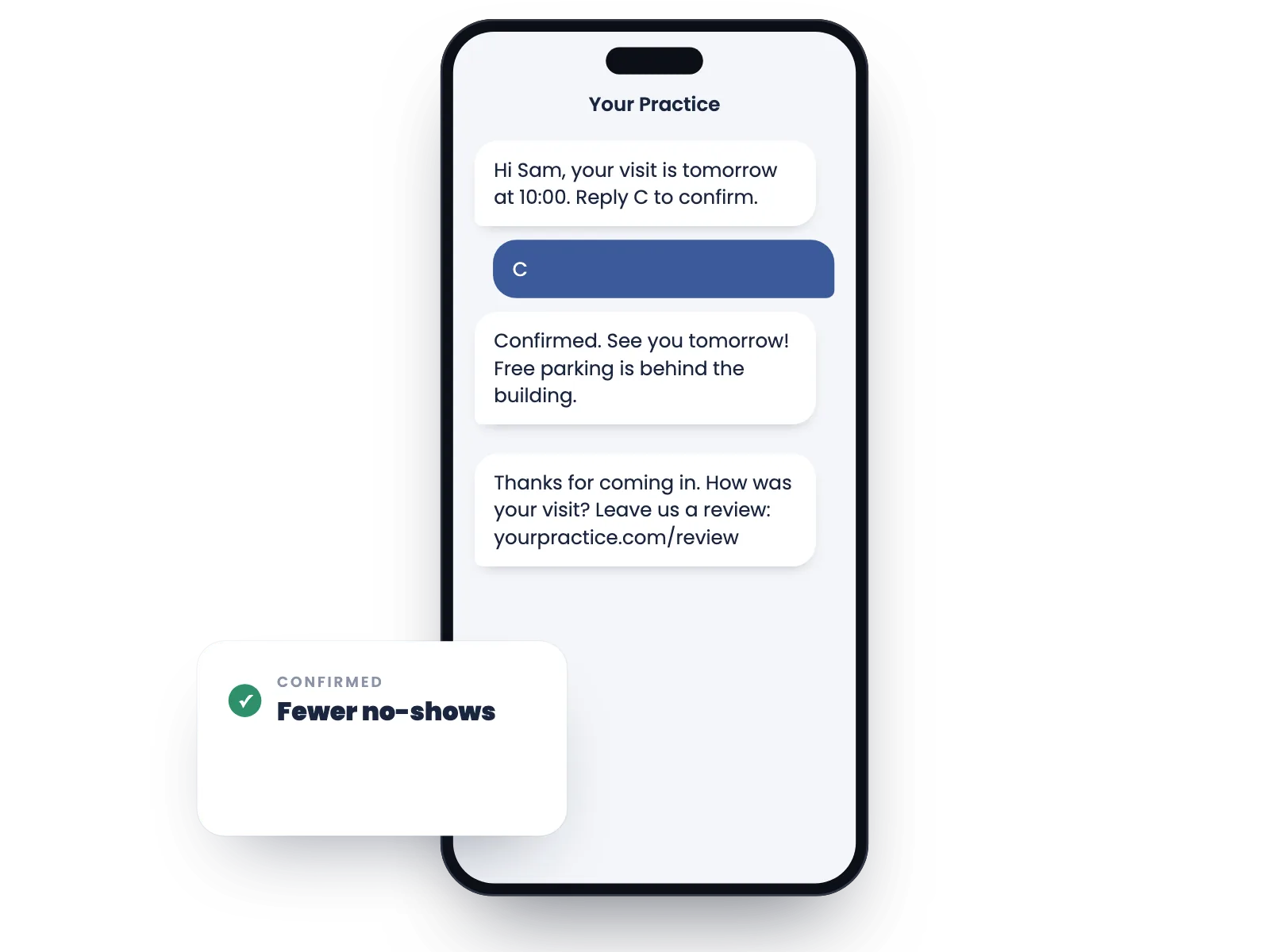
Mode two: automated texts (the right message, triggered automatically). This is the quietly powerful half, and it’s where the real operational revenue lives. Automated texts fire based on what’s happening: an appointment reminder before a visit, a confirmation when one’s booked, a post-visit follow-up, a birthday offer, a re-engagement message when a patient hasn’t been seen in a while. You set it up once and it runs, filling your calendar and protecting it without anyone lifting a finger.
Here’s why mode two matters more than most practices realize. A Cochrane review of eight randomized trials found text reminders raise appointment attendance compared with no reminder, and work about as well as phone calls for less cost.[1] For a practice, a no-show isn’t a missed text, it’s a lost slot that can’t be resold and revenue that’s simply gone. Automated SMS is the cheapest, most reliable way to protect the schedule you already have. The broader cross-channel workflows behind this live in our marketing automation service, and the leads these texts generate are worked through lead management.
The campaign side grows your bookings. The automated side protects them. You want both, and we build both.
Two decades in medical + aesthetic
We've run this channel for practices since before "texting your patients" was normal
Text marketing looks simple from the outside, send a message, get a booking. The practices that actually win at it do the unglamorous things right: a clean opted-in list, smart segmentation, the correct carrier registration, automated flows that fire on time, and copy that gets read instead of muted. We’ve marketed medical and aesthetic practices since 2003, through every shift in how patients want to be reached, and we know how to make SMS work in a regulated space without putting you at risk. We’re a Google Partner and a Meta Business Partner, we work month to month with a 30-day rolling engagement, and we bring a premium standard to a channel most agencies treat as an afterthought. Done right, it’s one of the highest-return tools a practice has. We make sure it’s done right. The core pain we close here is too many no-shows.
We know what reads, not what gets muted
A clean opted-in list, smart segmentation, and copy written to get read instead of muted, learned over two decades marketing medical and aesthetic practices.
We know the regulated space
We make SMS work in a regulated space without putting you at risk, the correct carrier registration, the consent rules, and the privacy lines a generic vendor tends to gloss over.
A premium standard on an afterthought channel
We bring a premium standard to a channel most agencies treat as an afterthought. Done right, it’s one of the highest-return tools a practice has.
Your most valuable SMS list isn't bought. It's the patients you already have.
This is the part that separates a real medical-marketing partner from a generic SMS vendor. The best text-marketing list in the world isn’t purchased or scraped, and it shouldn’t be. It starts with the patients who already know you, trust you, and are most likely to rebook. They are your highest-converting audience, and they’re already in your system.
In fact, most practices are sitting on this capability without using it. Most modern EMRs and practice-management systems already have SMS built in, connected directly to your patient base. The opt-in, the contact data, the appointment triggers, often it’s all right there. The work isn’t buying a list; it’s switching on and properly using what you already have, with the right consent in place.
Because every practice runs different software and is set up differently, we start with an assessment: what system you’re on, what it can already do, where the gaps are, and the cleanest, most compliant way to build and grow your opt-in list from there. Sometimes that means activating your existing platform; sometimes it means adding a dedicated solution and connecting it.
This is also the moment privacy matters most, because we’re working with your patients’ contact information. We approach it with HIPAA in mind and TCPA consent rules respected: every recipient has opted in, every message has a clear way to opt out, and we keep the whole thing privacy-first. We won’t cut corners here, and you wouldn’t want a partner who would.
Your website can grow the list too, an Urge Foundation lead-capture form, a keyword opt-in, but that’s the secondary, additive source. The core of a high-performing SMS program is the patient relationship you’ve already earned.
What's included
What we actually handle
Text marketing has real setup and real ongoing work behind it. Here's what we run.
Setup and number provisioning.
We get you texting properly, whether that’s enabling SMS on a number you already use or setting up a dedicated line, with the carrier registration today’s rules require.
List building and consent.
We help you build and grow a clean, opted-in list the right way, starting from your existing patient base and your practice software.
Segmentation.
Not every patient should get every text. We segment by treatment history, visit recency, and interest so messages land relevant, which is what keeps opt-out rates low.
Message and template writing.
The actual copy, campaign messages and automated templates, written to get read and get action, in your voice.
Automation building.
We set up the triggered flows: reminders, confirmations, follow-ups, birthdays, re-engagement, so they run on their own.
Two-way texting.
We can set you up to actually converse with patients by text, answer questions, confirm details, handle a reschedule, from a business number. It’s available through platforms including Twilio, and for most practices it’s worth having; texting is how patients increasingly prefer to communicate, and a real reply beats an auto-response.
Integration.
We connect your texting to the practice and CRM tools you already use, so it fits your workflow instead of adding another silo.
Reporting.
Clear numbers on what’s working: delivery, clicks, replies, opt-outs, and the campaigns and flows driving the most engagement.
Why Urge
Built to fill slots, cut no-shows, and respect consent
Two modes, both built.
Campaign blasts that grow your bookings and automated flows that protect them, run as one program instead of half a channel.
The list done right.
We start from your existing opted-in patient base and your practice software, with the right consent in place, not a bought or scraped list.
A regulated-space partner.
We approach SMS with HIPAA in mind and TCPA consent rules respected, the part generic vendors gloss over.
Premium on an afterthought channel.
Since 2003, a Google Partner and a Meta Business Partner, month to month, bringing a premium standard to a channel most agencies treat as an afterthought.
8
randomized trials in a Cochrane review of text reminders
Texts raised attendance versus no reminder. [1]
2
modes: campaign blasts and automated flows
Most practices only use one.
0
bought or scraped lists
Built from your opted-in patients.
2003
marketing practices since
Two decades in medical + aesthetic.
How it works
From assessment to texts that book
Assess
We look at what system you’re on, what it can already do, where the gaps are, and the cleanest, most compliant way to build and grow your opt-in list from there.
Set up
We get you texting properly, enabling SMS on a number you already use or setting up a dedicated line, with the carrier registration today’s rules require.
Build the list and the flows
We grow a clean, opted-in list from your patient base and stand up the triggered flows: reminders, confirmations, follow-ups, birthdays, re-engagement.
Send and converse
Campaign blasts go out segmented and on time, and two-way texting lets patients reply, confirm, or reschedule from a business number.
Report and refine
Clear numbers on delivery, clicks, replies, and opt-outs, so we keep the campaigns and flows that drive the most engagement.
Things you can do yourself, right now
We mean it. Whether or not you ever hire us, these genuinely help, and they’ll also show you how much thought good text marketing really takes:
- Check what your practice software already does. Before buying anything, look at your current EMR or scheduling system. Most already have SMS reminders and basic texting built in. Turning on automated appointment reminders alone can meaningfully cut your no-shows, and it may cost you nothing but a few minutes in settings.
- Turn on appointment reminder texts first. If you do one thing, do this. It’s the highest-return, lowest-effort SMS move there is, and it protects revenue you’ve already booked.
- Get consent the clean way. Only ever text patients who’ve opted in, and capture that opt-in clearly (at intake, on forms, at the front desk). Every message needs an easy opt-out. This isn’t just polite, it’s the law (TCPA), and it keeps you out of real trouble.
- Keep it short, timely, and useful. A text earns its place by being relevant. A last-minute opening, a genuine reminder, a real offer. Patients opt out fast from practices that blast noise, so send less and make each one count.
- Segment, even simply. At minimum, don’t send the same text to everyone. A patient due for a follow-up and a brand-new lead want different messages. Even basic segmentation lifts results and lowers opt-outs.
- Never put protected health information in a text, or confirm care publicly. Keep messages general. Don’t reference a specific diagnosis or treatment in a way that could expose private information, and remember texts can be seen on a lock screen. When in doubt, keep it generic and move specifics to a call.
- Mind the timing and frequency. Business hours, not late nights. And a sustainable cadence: many patients consider about one message a week plenty. Respect that and your list stays healthy.
- Always give a way out, every time. A visible opt-out in every message isn’t just required, it builds trust. A patient who knows they can leave easily is more comfortable staying.
If keeping all of that consistent, compliant, segmented, well-timed, and actually written well sounds like a real job, it is. That’s what we take off your plate, so the texts go out right, every time, and you can focus on patients.
Addressing the real concerns
"Isn't texting patients annoying or intrusive?"
Only when it’s done badly. Patients opt out fast from practices that blast irrelevant noise. But a timely reminder, a genuinely useful offer, or a real two-way reply is the opposite of intrusive, it’s the communication patients increasingly prefer. The difference is relevance, frequency, and consent, which is exactly what a managed program gets right and a spray-and-pray approach gets wrong.
"Is this even legal for a medical practice?"
Yes, when it’s done correctly. Text marketing is governed by TCPA (consent and opt-out rules) and, for anything touching patient information, handled with HIPAA in mind. Every recipient opts in, every message offers an easy opt-out, and protected health information stays out of the texts. We build the program to respect these rules from the start, which is the part generic vendors tend to gloss over.
"I already send appointment reminders through my software. Why do I need this?"
That’s a great start, and honestly, if your reminders are working, keep them. Where we add value is everything around that: campaign sends to fill slots and promote offers, smarter segmentation, re-engagement flows for lapsed patients, two-way conversations, and tying it all into a strategy instead of a single automated reminder. We assess what you already have and build on it, rather than replacing what works.
"How is this different from email marketing?"
Different strengths, and they pair well. Email is better for longer content, newsletters, and detailed offers. Text is better for anything time-sensitive and anything that needs to be seen now, openings, reminders, urgent offers. The best practices use email for depth and SMS for immediacy. They’re teammates, not substitutes.
Selected work
Texts that filled slots and protected the schedule
A few examples of the work, and what changed once the texts went out right.
MedSpa
Last-minute openings, filled the same day
A segmented campaign program for flash offers and same-day openings, so empty slots got filled instead of lost.
- Text Marketing
- Campaigns
Dental
No-shows down on autopilot
Automated appointment reminders and confirmations switched on and tuned, so the schedule held without anyone at the desk chasing it.
- Text Marketing
- Automation
Dermatology
Quiet patients brought back
A re-engagement flow for patients who’d gone quiet, plus two-way texting so replies turned into rebooked visits.
- Text Marketing
- Two-way
Results vary by practice and market. The work above is shown for the kind of problem we solve, not as a performance guarantee.

Prefer a human over a contact form?
Talk with a senior strategist who’s helped practices grow since 2003, no bots, no junior rep.
FAQ
Text Marketing questions, answered
Text marketing (SMS marketing) is the use of text messages to reach a practice’s patients, in two modes: broadcast campaigns like promotions and announcements, and automated triggered messages like appointment reminders, confirmations, and follow-ups. It relies on an opt-in patient list, and most people read text messages within minutes.
Most people read text messages within minutes, while marketing emails often wait hours or days to be opened. Texts land directly on a phone, which makes SMS ideal for time-sensitive messages like openings and reminders.
Yes. A Cochrane review of eight randomized trials found text reminders raise appointment attendance compared with no reminder, and work about as well as phone calls for less cost. Automated reminders are one of the highest-return uses of SMS for a practice.
From your existing, opted-in patient base, the people who already know and trust your practice. Most EMR and practice-management systems already have SMS and patient contact data built in. We assess your specific setup and build a clean, consented list from there, with your website as a secondary source of new sign-ups.
Yes, when done correctly. It follows TCPA consent and opt-out rules, and anything involving patient information is handled with HIPAA in mind, every recipient opts in, every message has an easy opt-out, and protected health information stays out of the texts.
Yes. We can set up two-way texting so patients can reply, ask questions, confirm details, or reschedule, from a business number. It’s available through platforms including Twilio, and for most practices it’s a valuable way to meet patients on the channel they prefer.
Often, yes. We can enable SMS on a number you already use or set up a dedicated line, and we connect text marketing to the practice and CRM tools you already run. We start with an assessment of your current setup to find the best fit.
No. Urge engagements are month-to-month, with the only requirement being 30 days’ notice of cancellation.
Still have a question we didn't answer?
Send it over and a strategist will reply with a straight answer (and a tailored plan) within one business day.
Sources
Related Insights
Let's grow your practice
Let's turn texts into booked appointments
Fill open slots, cut no-shows, and stay in your patients' pocket, the right way, with consent and privacy built in. Let's set up a text program that works.