“Our experience with Urge was a complete transformation. From day one they were fully engaged, from revamping our website to social content, they delivered at every turn.”
Services · Google Ads
Google Ads That Book Patients, Not Just Clicks
When a patient is ready to book, they don't scroll. They search, or they ask AI.
Google Ads puts your practice in front of patients at the exact moment they are searching for what you offer, ready to act. We build and manage Search and Performance Max campaigns for medical and aesthetic practices, engineered to turn that high intent into qualified patient leads, not just clicks.
- Certified Google Partner
- Built for high-intent patient searches
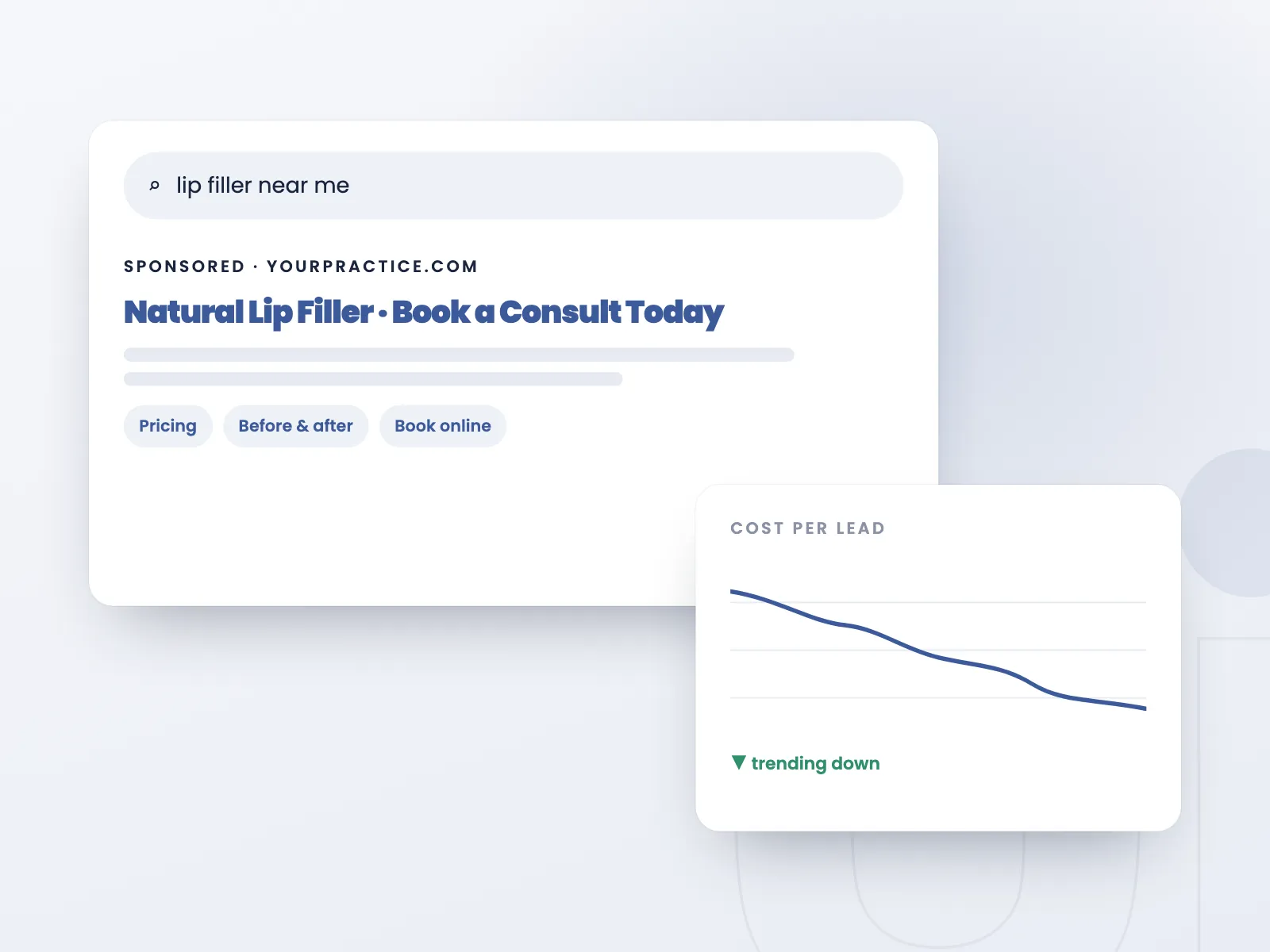
- Tracked to cost-per-lead, honest about the rest
OVERVIEW
Google Ads for practices runs paid Search and Performance Max campaigns that capture patients actively searching for treatments, the highest-intent moment in marketing. Urge is a certified Google Partner serving medical and aesthetic practices across the US and Canada, with privacy-first, consent-based conversion tracking and landing pages built to convert. In Google’s 2016 research, 76% of people who searched on a smartphone for something nearby visited a related business within a day. Urge has marketed aesthetic practices since 2003.
The honest question
Is your ad spend actually finding patients, or just spending?
Google Ads has one job: turn high-intent searches into real patient inquiries, not just clicks. Here is where most practice campaigns quietly leak budget.
-
You're paying for clicks, not patients. Traffic that never becomes an inquiry is just budget set on fire. The fix is not more clicks, it is the right clicks pointed at a page built to convert.
-
You don't know your cost per lead. Without proper conversion tracking tied to real form fills and calls, you are optimizing blind, and so is anyone managing your account.
-
Competitors are outbidding you on your own name. When someone searches for your practice by name and a competitor’s ad shows up first, you are paying to defend ground you should already own, or losing it.
-
Your budget burns out by mid-month. Loose match types and missing negative keywords spend fast on searches that never had a chance to book.
-
Great ads, weak landing page. The best-written ad in the world fails when the click lands on a slow, generic homepage instead of a page built for that exact search. You cannot out-bid a bad landing experience.
-
You're guessing at the rules. Google’s healthcare advertising policies are strict, and a single disapproved term can stall an account. Most practices learn that the hard way.
Two decades in medical + aesthetic
We don't run ads for everyone. We run them for practices like yours.
We have marketed medical and aesthetic practices since 2003, and run Google Ads for them for more than fifteen years: dermatology, plastic surgery, MedSpas, dental, OB-GYN, ophthalmology, general practice, and wellness practices across the US and Canada, plus hospital systems and larger medical groups. We already know what a new patient is worth, the terms they search before they ever call, and the compliance lines you cannot cross, so your budget is not paying for our learning curve.
We know what a patient is worth
We set bids and budgets around the real value of a new patient in your specialty, so a derm chasing $200 visits and a plastic surgeon chasing $15,000 procedures are never managed the same way. Spend follows what each search is actually worth to you.
We know the rules (this is the one that gets people shut down)
Google’s healthcare advertising policies are strict and specific, and breaking them, usually without realizing it, gets entire accounts suspended. We have lost count of the practices that came to us after running their own ads, or hiring a generalist, and getting shut down overnight for a claim or a restricted term they did not know was off-limits. We handle compliance from day one, because in aesthetic medicine the rules are their own expertise, and almost nobody outside this niche knows them cold.
We know what converts
More than fifteen years of medical and aesthetic search-ad data sits behind every keyword, audience, and landing-page decision, what patients actually search before they book, which terms waste money, and what makes them pick up the phone instead of bouncing.
The three things aesthetic practices hate about Google Ads (and what we do about them)
If you have run Google Ads for a MedSpa, dermatology, or plastic surgery practice, or watched an agency run them badly, you already know the three complaints. We hear them constantly, because they are real. Here they are, and here is exactly what we do instead.
1. The clicks cost a fortune, and half of them are price shoppers
Aesthetic keywords are some of the most expensive in all of Google. Terms like “CoolSculpting near me” or “breast augmentation surgeon” can run well into double digits per click, and nothing stings like watching that budget get eaten by bargain hunters who click, scan for a Groupon-style deal, and bounce. The fix is not to outspend them, it is to stop inviting them. We target the high-intent searches that signal a real patient (think “board-certified [procedure]” or “[procedure] specialist”) over the broad, cheap-traffic terms, and we point the click at a page that sells your outcome and your expertise, not a number. Premium practices win by attracting premium patients, not by racing discount-seekers to the bottom.
2. The leads are junk, and your front desk pays for it
Broad targeting brings in clicks for DIY filler kits, drugstore skincare, people who want to become injectors, and outright bots filling your forms. On paper your conversions look great. On the calendar, nothing. This is the attribution lie all over again, inflated numbers that never become patients, and it is usually downstream of the platform’s own defaults, which are tuned for volume because volume means spend. We attack it from three sides: a ruthless negative-keyword list (cheap, free, coupon, school, certification, and the rest) to filter the bargain and DIY crowd, form-level protection to stop the bots, and qualifying fields that gently weed out the casual browser. Your team chases real consults, not ghosts.
3. The ads keep getting disapproved, and nobody tells you why
Google’s healthcare advertising rules are strict, specific, and getting stricter. Brand-name injectables like Botox and Juvederm are restricted drug terms, and as of late 2025 you need Google certification even to bid on them.[3] Treatments that sound experimental to Google’s systems, PRP among them, can get flagged as speculative. Personalized-advertising rules limit how you can speak to a patient’s condition, and your landing page cannot capture health information the way a generic lead form does. Generalist agencies and DIY accounts trip these wires constantly, sometimes losing the whole account. We keep your campaigns inside the lines on purpose: compliant ad copy built on outcomes and credentials, the certifications handled for you, and landing pages built so a policy bot has nothing to flag.
What's included
Everything your ad budget needs to perform
One team running the ad and the landing page together, so there is no finger-pointing between the agency that drove the click and whoever built the page it landed on.
Google Partner management
Certified strategists actively managing your account by hand, not a set-and-forget automated bot.
Search + Performance Max
The right campaign mix to capture high-intent searches and qualified reach across Google’s network, structured for your specialty and your market.
Privacy-first conversion tracking
Consent-based tracking that ties spend to the things we can truly measure: clicks, form fills, and calls.
Landing pages that convert
Fast, on-brand pages built on Urge Foundation and tuned to the exact search that drove the click, so interest turns into an inquiry instead of a bounce.
Smart bidding + negative keywords
Budget steered toward the terms that produce inquiries and away from the ones that quietly waste your spend.
Transparent reporting
Clear dashboards tied to leads and cost-per-lead, with an honest read on what we can and cannot see, never vanity clicks.
Why Urge
Built to be found, trusted, and booked
We optimize for inquiries, not clicks.
Every campaign is engineered around cost-per-lead and the value of a new patient, not the vanity metrics that look good in a screenshot and pay none of your bills.
Certified Google Partner.
Direct access to Google’s tools, betas, and support, applied straight to your account.
Ad and landing page under one roof.
We build the page the click lands on, so the whole funnel is tuned together instead of handed between vendors who never talk.
Two decades in medical marketing.
We have marketed medical and aesthetic practices since 2003 and run Google Ads for them for more than fifteen years. We know your patients, your procedures, and your rules.
15
+
years running Google Ads for practices
As a certified Google Partner.
2003
marketing aesthetic practices since
Two decades in medical and aesthetics.
How it works
From audit to optimization
Audit
We review your account, competitors, and tracking, and baseline your true cost-per-lead before we promise anything.
Plan
Campaign structure, keywords, audiences, and budget mapped to your patient-acquisition goals.
Build
Campaigns, privacy-first conversion tracking, and a landing page built to convert, all wired together.
Launch
Go live with clean tracking and the budget guardrails that protect your spend from day one.
Optimize
Weekly bid, keyword, and creative tuning, with reporting tied to leads and cost-per-lead.
The whole point of Google: these patients are already looking for you
Here is what makes search different from every other channel, and why it belongs at the center of most practices’ ad budgets. On Facebook or Instagram, you interrupt people who weren’t thinking about you. On Google, you reach people who are actively searching for exactly what you offer, right now, with their wallet halfway out.
The intent is real and it is fast. In Google’s 2016 research, 76% of people who searched on a smartphone for something nearby visited a related business within a day,[1] and 28% of those searches led to a purchase.[2] Someone typing “plastic surgeon near me,” or asking an AI assistant who the best provider is, is not browsing. They are choosing. Google is now placing ads inside its AI answers too, so Google Ads keeps your practice in the conversation even as search becomes one. (Showing up in those answers organically is its own discipline, AI Search Optimization.) This is how you make sure your practice is one of the names a ready-to-book patient chooses between.
That is also why Google pairs so well with the rest of your marketing. Your Facebook and Instagram ads create demand and fill the top of the funnel; Google captures the high-intent searches that demand produces; and your email follow-up converts the leads that don’t book on the first visit. We will tell you honestly where Google should sit in that mix for your goals, sometimes it is the whole budget, sometimes it is the anchor.
Google wants you to spend more. We want your spend to work.
Here is something worth understanding about all the free help. Google will gladly assign you a rep, and its AI will gladly “optimize” your account for you, and plenty of practices take the offer because it sounds easy and it costs nothing. But remember whose business that is. Google makes money when you spend more, not when your cost per patient goes down. Its automation and its reps are pointed at one number, your budget, and the advice tends to run in one direction: spend more, broaden your targeting, turn on more.
Our incentive is the opposite one. We are independent, and we win when your spend works, when the right patients come in at a cost that makes sense, not when the invoice gets bigger. So we do the unglamorous things the automation quietly glosses over: cutting wasted spend, adding negative keywords, turning things off, and pushing back when “spend more” is not the answer. The help Google offers is free for a reason. Your budget deserves someone sitting on your side of the table.
Selected work
What the right campaigns actually look like
A few examples of the work, and the thinking behind it.
Plastic surgery
Rebuilt around what patients actually search
Search and Performance Max rebuilt around high-intent procedure terms, with call tracking so real inquiries could be tied to spend instead of guessed at.
- Google Ads
- Landing Page
Ophthalmology
Wasted spend, cut and reinvested
Wasted spend cut with tight geo-targeting and a deep negative-keyword list, then reinvested into the terms that actually produced inquiries.
- Google Ads
- Local
Plastic surgery
A page built to convert the click
A dedicated, fast landing page paired with the ad set, so the high-intent click had somewhere built to convert instead of a generic homepage.
Results vary by market, budget, and procedure value, and the final booked-and-paid step lives in your practice’s own data, not ours. We baseline your true cost-per-lead before we promise anything.

Prefer a human over a contact form?
Talk with someone who’s been running aesthetic ad budgets since before “PPC” was a buzzword. Since 2003, no bots, no junior rep.
FAQ
Google Ads questions, answered
It depends on your market, your specialty, and the value of a new patient, so we do not quote a one-size number. We set a budget around your target cost-per-lead and scale only what stays efficient. In competitive aesthetic markets, high-intent procedure terms can be expensive per click, which is exactly why structure, negative keywords, and a strong landing page matter more than raw budget. We recommend a starting range after a short audit.
Aesthetic keywords are among the most expensive in all of Google, because the procedures are high value and every practice in your market is bidding on the same terms. The mistake is treating that as a reason to spend more. We treat it as a reason to spend precisely: targeting the searches that signal a serious patient, filtering out the bargain hunters with negative keywords, and sending the click to a page that sells your expertise instead of competing on price. The goal is a sensible cost per qualified lead, not the cheapest possible click.
They are different, and the smartest practices use both. Someone clicking a Google ad is searching with intent and ready to act now, so search leads tend to be higher-intent and closer to booking. Facebook and Instagram reach people earlier, before they would ever search, creating demand that Google then captures. Search is your high-intent capture; social is your demand generation. We will tell you honestly which mix fits your goals and budget.
We will be straight with you, because most agencies are not. We can measure what is genuinely trackable: clicks, form fills, and phone calls (where call tracking is set up), and the cost of each. What no ad platform or agency can see on its own is the final step, whether a given lead booked, showed, and paid, because that lives inside your practice or EMR. Anyone promising to prove the entire funnel is overpromising. So we optimize to qualified leads at a sensible cost and work with your front desk and your numbers to understand what is really converting.
Yes. Everything is built with HIPAA in mind and a privacy-first approach. Conversion tracking is consent-based, so it fires for visitors who opt in, and it is set up so patient health information is not exposed to the ad platform. We also follow Google’s healthcare advertising policies and the advertising standards specific to medical and aesthetic services, the judgment a generalist or an automated tool simply does not have.
Almost always because of Google’s healthcare advertising policies, which are strict and specific to medical and aesthetic services. Brand-name injectables are restricted drug terms that now require certification to target, some treatments get flagged as speculative, and personalized-advertising rules limit how you can reference a patient’s condition.[3] A disapproval is usually a sign the account is being run by someone who does not know these rules cold. We handle compliance from the start, ad copy, certifications, and landing pages, so your ads run instead of sitting in review.
No. We work month to month, on a thirty-day rolling basis, so we earn the next month by performing in the current one. The only thing we ask is thirty days’ notice if you ever decide to cancel. No multi-year lock-in, no early-termination penalty.
Yes, and honestly it is one of the most common reasons campaigns underperform. We build the landing page the click lands on, on Urge Foundation, tuned to the exact search, so your ad spend is not pouring high-intent traffic onto a page that was never built to convert. The ad and the page are managed together, as one funnel.
This is one of the most debated questions in paid search, and our answer is not the usual one. Conventional wisdom says build a stripped-down landing page for every campaign, and sometimes that is exactly right. But a single-purpose page shows a patient one thing. When your site is built on Urge Foundation, we can often send that high-intent click to the actual treatment or concern page instead, where our concern-to-treatment correlation surfaces related options the patient did not know to ask for. Someone who clicked an ad for one treatment discovers the one that is actually a better fit, and books that. That cross-sell does not happen on a one-note landing page.
In the ideal case your site is an Urge build, beautiful and engineered to convert, so we route traffic where it both converts and grows the value of the visit. When a client cannot or will not build a new site, we build a dedicated, fast landing page instead, and tune it hard. Either way we make the call based on what actually converts and what grows the visit, not a one-size rule someone read in a blog.
You will see clicks and leads quickly, often within the first weeks, because search captures existing demand rather than building it. The first 60 to 90 days are about learning: tightening keywords, cutting waste, and improving the landing experience so your cost-per-lead comes down and holds. We report in plain language the whole way, so you always know what your spend is doing.
Still have a question we didn't answer?
Send it over and a strategist will reply with a straight answer (and a tailored plan) within one business day.
Sources
Related Insights
Let's grow your practice
Ready for Google Ads that find patients, not just clicks?
Book a free ad audit and we'll show you the three highest-impact fixes, no pitch deck required.