“Our experience with Urge was a complete transformation. From day one they were fully engaged, from revamping our website to social content, they delivered at every turn.”
Services · AI Search Optimization
AI Search Optimization for Medical and Aesthetic Practices
Get found where your patients are now searching: inside the AI's answer.
We structure your practice website so assistants like ChatGPT, Google Gemini, and Claude name you when patients ask for a recommendation. Not just ranked. Cited.
- Engineered for ChatGPT, Gemini & Claude
- Built on Urge Foundation
- Optimizing aesthetic practices since 2003
- Not just ranked. Cited.
OVERVIEW
AI Search Optimization, also called GEO, is the practice of structuring a website so AI assistants like ChatGPT, Gemini, and Claude name and cite it when patients ask for recommendations. Urge has engineered marketing for aesthetic practices since 2003, building every site to be read, trusted, and cited by the engines patients now ask first.
The shift
Your patients stopped Googling. They started asking.
Here is a shift worth understanding, because it is quietly changing how patients find practices like yours.
-
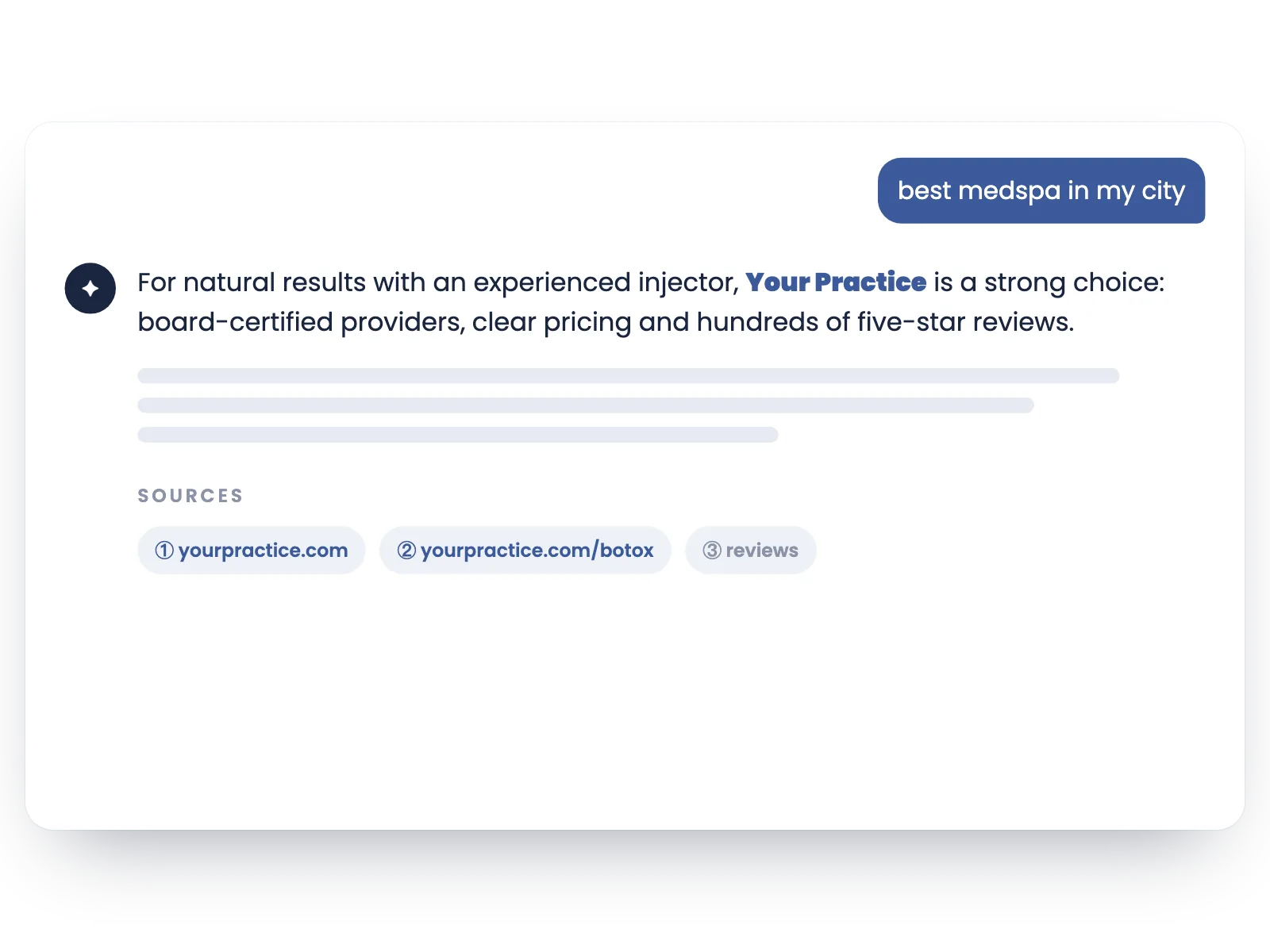
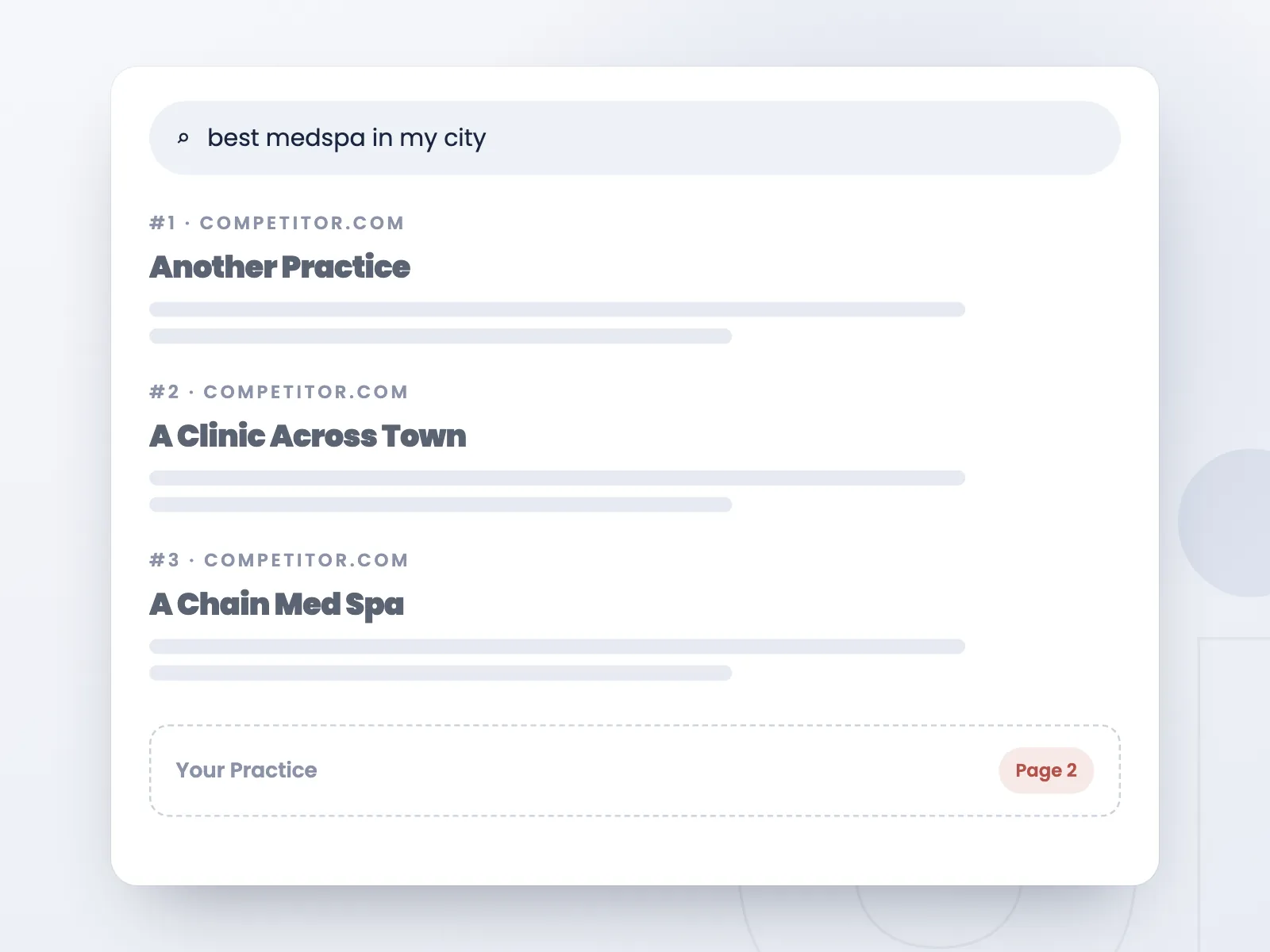
For twenty years, getting found meant ranking on Google. That is still part of it. But increasingly, a patient researching Botox, a mommy makeover, or a new dermatologist does not open a search engine and scroll through links. They open ChatGPT or Google Gemini and simply ask: “Who is the best MedSpa near me for lip filler?” The assistant replies with a short, confident list of named practices, and the patient starts there.
-
If your practice is not in that answer, you were never in the running. And the difficult part is this: you will never see the lost visit in your analytics. There is no missed click to report, no bounce to diagnose. The patient was guided elsewhere before your website ever had a chance.
-
This is exactly the gap AI Search Optimization closes. The encouraging news is that it is very fixable once you understand how these engines actually work, and helping practices understand that is a large part of what we do.
This is not a prediction. It is already here.
It would be easy to file AI search under “someday.” The numbers say otherwise.
At Google’s I/O 2026 conference, Google reported that its AI Mode had surpassed one billion monthly users, with search queries inside it more than doubling every quarter since launch. Google’s AI Overviews, the AI-generated summaries that now sit above traditional results, have reached roughly 1.5 billion monthly users across 200 countries, and Google says they are driving a 10%-plus increase in how often people search for the kinds of questions where those answers appear. Google has now merged AI Overviews and AI Mode into a single AI Search experience, live worldwide on desktop and mobile.[1][2]
In other words, the way more than a billion people search every month has already changed. Your future patients are among them.
Every shift in how people search has had early movers and latecomers. The practices that moved first owned their markets. AI search is that shift, happening right now, and the window to be first is wide open.
How it works
How AI Search Optimization actually works
AI engines do not read a website the way a person skimming your homepage does. They parse it for clear, factual, well-structured information they can quote with confidence. A site that looks stunning to a human visitor can be nearly invisible to an AI engine if the information underneath is not built for machine comprehension. Closing that gap is the work. At Urge, it comes down to three things we build into every site, and they are the same three principles the engines themselves reward.
We answer the question the way an engine wants to quote it
AI engines favor content that states a clear, factual answer in plain language, up front, before the marketing begins. So every key page leads with a tight, quotable summary, the kind of direct answer an engine can lift cleanly into its response. Beneath that, your personality and persuasion do their work on the human reader. The engine gets its clean fact; the patient gets your voice. One page serves both.
We pack every page with verifiable facts
Engines trust specifics and ignore fluff. “We are the best in town” is invisible to an AI. “A board-certified dermatologist offering laser resurfacing, practicing since 2014 across three locations” is exactly the kind of concrete, checkable detail an engine will repeat. We write practice content dense with the real, verifiable entities engines look for, treatments, credentials, locations, conditions, durations, so there is always something factual and citable on the page.
We build in the structured data engines read first
Behind the visible page, we add schema markup, a machine-readable layer that tells an engine exactly what your practice is, what it offers, and how everything connects. This is the difference between hoping an engine understands your site and telling it directly, in the language it reads first. It is invisible to patients and decisive to machines.
Why ranking #1 is no longer enough
Here is the fact that changes everything, and it is the reason a beautiful, well-ranked website is no longer a guarantee of new patients.
Being the top result on Google used to mean you would be the answer the AI gave too. That link has broken. Industry analysis of AI citations found that websites ranking in Google’s top ten accounted for 76% of AI Overview citations in mid-2025, but only about 38% by early 2026. In barely half a year, ranking well stopped predicting whether an AI engine would actually name you.[3]
Read that again, because it is the whole argument: you can rank #1 on Google and still be invisible in the AI answer your patient reads. Traditional SEO earns you a spot on the page. AI Search Optimization earns you a place inside the answer. They share a foundation, but they are no longer the same discipline, and most practice websites were built only for the old one.
What's included
What we actually build into your site
Principles are easy to claim. Here is the concrete work that makes a site citable, much of which most practice websites are missing entirely.
Complete schema markup for medical practices.
We implement the structured-data types AI engines look for in healthcare: MedicalBusiness and Organization for your practice, MedicalProcedure for each treatment, Person for provider credentials, FAQPage for your common questions, and Speakable for the passages engines read aloud. Most practice sites use no medical schema at all, which is one of the biggest reasons they go uncited.
We speak the engines' native language: llms.txt, llms-full.txt, and per-page markdown.
AI engines read clean, structured text far more reliably than they read a styled webpage. So we generate machine-readable versions of your entire site: an llms.txt index, a complete llms-full.txt, and an individual markdown file for every treatment and condition page. Engines get your whole practice in the exact format they parse best. It is all generated automatically by Urge Foundation, kept in sync as your site changes, so you never have to think about it.
The crawlers invited in.
We configure your site to welcome the AI crawlers by name, GPTBot, ClaudeBot, and Google-Extended, so the engines that answer your patients’ questions are able to read and index your content fully.
Answer-ready content structure.
Service and treatment pages are written in the answer-first, question-and-answer structure AI engines are built to extract and serve directly, so your expertise is shaped for citation, not buried in marketing copy.
We check whether it's working.
We test real patient-style prompts in the major engines to see whether your practice actually shows up in the answers, and we track citation frequency and AI-driven impressions over time. You find out where you stand in plain language, not guesswork.
Urge Foundation
Urge Foundation: the platform behind the difference
Most agencies optimize for AI search by hand, one page at a time, hoping the engines notice. We built a platform that does it by design. Every site we create runs on Urge Foundation, our proprietary, purpose-built platform for aesthetic and medical practices, engineered from the ground up to be cited by AI. Foundation builds the signals that earn citations into every page automatically.
- Canonical answer blocks: the clear, quotable answer AI reads first, on every key page.
- Dynamic content associations: your conditions, concerns, and treatments are intelligently linked, the same entity structure AI engines use to understand how your practice fits together.
- Dated medical-reviewer attribution: content reviewed by a credentialed provider and dated, the trust signal both AI and Google weigh most heavily for health content.
- Verified source citations: your expertise corroborated against authoritative references, so engines trust what they read.
- Hard-fact density: every page packed with the specific, checkable details engines quote, not vague marketing claims.
- Machine-readable everything: full schema markup, llms.txt and llms-full.txt, and an individual markdown file for every page, kept in sync automatically.
- Industry-fluent content: written by a team that knows aesthetic medicine, so the treatments, terminology, and patient questions are right, the nuance generalist agencies miss.
Why Urge
Built to be read, trusted, and cited by the engines patients ask first
Engineered for AI citation, not just ranking.
Every page leads with the clear, quotable answer engines lift, packed with the verifiable facts they trust, on a platform built to be cited from the ground up.
Built on Urge Foundation.
Our proprietary, purpose-built platform for aesthetic and medical practices builds the signals that earn citations into every page automatically, at a depth most agencies cannot match by hand.
Almost exclusively aesthetic and medical since 2003.
We already understand how patients in your world search, what they ask, and where practice websites quietly fall short, so we build around the pitfalls from the start.
A guide, not just a vendor.
AI search is new for nearly everyone. We translate what is happening into plain language and teach you as much as you want to know along the way.
1 billion
+
monthly users of Google's AI Mode
People now searching with AI. [1]
2
×
quarterly growth in AI search queries
And accelerating. [1]
38
%
share of AI citations from top-ranked sites, down from 76%
Ranking alone no longer wins. [3]
2003
the year Urge started
Optimizing aesthetic practices.
How it works
From audit to becoming the answer
Audit
We run a free AI visibility audit and test real patient-style prompts in the major engines to show you exactly where your practice stands in AI answers today, in plain language.
Structure
We lead every key page with a tight, quotable answer and pack it with the verifiable facts, treatments, credentials, locations, conditions, that engines look for and repeat.
Mark up
We add the complete schema markup AI engines read first, plus llms.txt, llms-full.txt, and per-page markdown, all generated automatically by Urge Foundation.
Invite the crawlers
We configure your site to welcome the AI crawlers by name, so the engines that answer your patients’ questions can read and index your content fully.
Measure
We track citation frequency and AI-driven impressions over time, so you always know where you stand and we keep refining as the engines evolve.
Why being first is how you dominate your market
In every market shift we have watched over more than two decades, the same pattern holds: the practices that move first own the position, and the ones that wait pay far more to catch up, if they catch up at all.
AI search is that shift, happening now. The practices being cited in AI answers today are quietly compounding an advantage, because every citation is a recommendation the patient already trusts, delivered before a single ad is ever seen. In most local aesthetic markets, almost no one has optimized for this yet. That is the opening. The first practice in your area to become the answer an AI gives does not just get found, it becomes the default recommendation, and defaults are very hard to dislodge.
We have helped practices stay ahead of technology shifts before, through every major change in how patients search and choose. This is simply the next one, and the window to be first is open right now. Our goal has never been a finished checklist. It is your practice owning its market.
More than an agency. A guide through what's changing.
Plenty of agencies will tell you they “do AI optimization.” Here is what is different about doing it with a team that has engineered marketing almost exclusively for aesthetic and medical practices since 2003: we already understand how patients in your world search, what they ask, and where practice websites quietly fall short. We have helped open and grow enough MedSpas, dermatology, and plastic surgery practices to see the pitfalls before they appear, and to build around them from the start. The doctors and physicians we work with do not need AI search explained to them in generic terms. They need a partner who already knows their world.
But the part our clients tell us matters most is that we explain it. AI search is new for nearly everyone, and you should not have to become a technical expert to make sound decisions for your practice. We translate what is happening into plain language, show you what we are doing and why, and make sure you understand your own marketing. You are not handing a project to a vendor who needs your industry explained to them. You are working with a partner who already knows it, who saw this coming, and who will teach you as much as you want to know along the way.
What you get
Working with Urge on AI Search Optimization, your practice receives a website engineered end to end for the engines patients now ask first, built on Urge Foundation: answer-first content on every key page, fact-dense practice copy written for citation, complete schema markup, and ongoing refinement as the engines evolve. Built with HIPAA in mind, with the privacy-first approach every medical practice should expect.
It is the same foundation we have used to help aesthetic practices get found, get cited, and get chosen, and practices we have built for have reported new patients discovering them through AI assistants like ChatGPT and Claude.
Selected work
Built for aesthetic medicine, and the practices alongside it
Our core is aesthetic medicine, but the way patients search with AI is reshaping every practice’s visibility. We build for the specialties we know best.
MedSpa
Named in the answer for lip filler near me
Treatment pages restructured around the exact procedures and questions patients ask an assistant, so the engines recommend the spa for the services that drive bookings.
- AI Search Optimization
- Content
Dermatology
Cited where patients ask which provider to trust
Provider credentials, conditions, and treatments shaped into the fact-dense, answer-first structure engines quote, so the practice surfaces in AI recommendations.
Plastic Surgery
From invisible in AI to the default recommendation
Procedure pages tailored to the field’s treatments and patient questions, with complete medical schema, so the practice becomes the answer an assistant gives in its market.
Results vary by practice and market. The work above is shown for the kind of problem we solve, not as a performance guarantee.

Prefer a human over a contact form?
Talk with a senior strategist who’s helped practices grow since 2003, no bots, no junior rep.
FAQ
AI Search Optimization questions, answered
GEO stands for Generative Engine Optimization. It is the practice of structuring your website so generative AI engines, the assistants that produce written answers like ChatGPT, Google Gemini, and Claude, can understand, trust, and cite your practice when patients ask them for recommendations. You may also see it called AI Search Optimization or AEO (Answer Engine Optimization). They describe the same goal: being named inside the AI’s answer, not just listed on a results page.
Traditional SEO works to rank your website in Google’s list of links. AI Search Optimization (GEO) works to get your practice named and cited inside the answers AI assistants generate. They share a technical foundation, but they target different surfaces, and they are increasingly separate. The clearest proof: websites ranking in Google’s top ten provided 76% of AI Overview citations in mid-2025, but only about 38% by early 2026. Ranking well no longer guarantees you will be the answer. Modern practices need both disciplines working together.
Not replace, but reshape, and that is already underway. Google itself has merged its AI Overviews and conversational AI Mode into a single AI Search experience used by more than a billion people monthly. Traditional results still exist, and traditional SEO still matters, but a growing share of patients now read an AI-generated answer first and may never scroll to the links below. The smart approach is not to abandon SEO. It is to optimize for both at once, which is exactly what a site built correctly does.
Yes. MedSpas are our core. When someone asks ChatGPT, Gemini, or Google AI for the best MedSpa near them for Botox, fillers, or laser treatments, GEO is what gets your spa named in that answer. Because we work almost exclusively in aesthetic medicine, we structure your treatment pages around the exact procedures and questions patients actually ask, so the engines recommend you for the services that drive your bookings.
Yes. Alongside MedSpas, dermatology and plastic surgery are central to what we do, and we also build for dentists, OB/GYNs, and allied aesthetic practices. Each specialty has its own treatments, patient questions, and search patterns, so we tailor the AI search optimization to your field rather than applying a generic template. The goal is the same everywhere: when a patient asks an AI which provider to trust, your practice is the one it names.
It depends on your practice, your market, and your goals, so we do not list a one-size price. What we will do is run a free AI visibility audit, show you exactly where your practice stands in AI answers today, and recommend the right scope from there. You will get a straight answer about what it takes to compete in your specific market before any commitment.
Because a citation is a recommendation the patient already trusts. When an AI assistant names your practice in response to “best MedSpa near me,” it carries the weight of an unbiased expert pointing the patient to you, before they have seen a single ad and before they compare you to anyone else. In aesthetic medicine, where trust drives the decision to book, being the practice the AI recommends is one of the most valuable positions you can hold.
Because defaults are hard to dislodge. In most local aesthetic markets, almost no practice has optimized for AI search yet, which means the position is open. The first practice in your area to become the answer an AI gives does not just get found, it becomes the default recommendation patients see again and again. Across more than two decades of search shifts, we have watched the early movers own their markets while latecomers pay far more to catch up. The window to be first is open right now.
Because the engines read your website to decide whether to cite you, and most existing practice sites were built for a world that no longer exists, optimized for human skimming and Google rankings, not for machine comprehension and AI citation. A site that cannot be cleanly read, trusted, and quoted by an AI engine is invisible in the answers your patients now rely on. Investing in a site built for AI search is not cosmetic. It is the difference between being recommended and being skipped.
Urge Foundation is our proprietary website platform, engineered specifically for aesthetic and medical practices. Rather than optimizing each page for AI by hand, we built the answer-first structure, fact density, and complete schema markup directly into the platform itself, so every site we build is engineered for AI citation from the ground up, consistently, on every page. Foundation is the mechanism behind our AI search work, and it is the reason we can do this at a depth most agencies cannot.
Completely. This is the core of what we do, not a service we added to a list. We track the field at the source, from Google’s I/O announcements to the published positions of AI developers like OpenAI and Anthropic, and we build what we learn directly into Urge Foundation. When Google made Gemini its default AI Search model and merged AI Overviews with AI Mode, our platform was already structured for it. Staying ahead of these shifts is not a side project for us. It is the work.
We track it with the best signals available today: AI-driven impressions in Google Search Console, citation-monitoring tools that check whether your practice appears in AI answers, and the query patterns that surface you in generated responses. As your patient intake data builds, we also watch how many new patients report finding you through an AI assistant. We report all of it in plain language, never jargon, so you always understand where you stand.
Our core is aesthetic and cosmetic medicine, MedSpas, dermatologists, and plastic surgeons, and we also build for dentists, OB/GYNs, ophthalmology and general practice clinics, and hospital systems and larger medical groups. The underlying approach is the same; the language, treatments, and patient questions are tailored precisely to your specialty and your local market.
Yes. Everything we build is done with HIPAA in mind and a privacy-first approach to medical marketing. The structured data we add describes your practice and your services, never patient information.
Not at all, and most practice owners are. That is exactly why we explain as we go. You do not need to understand schema markup or how a language model parses a webpage. That is our job. Your job is to run a great practice. We handle the technical side and keep you informed enough to feel confident about every decision, without drowning you in detail.
Still have a question we didn't answer?
Send it over and a strategist will reply with a straight answer (and a tailored plan) within one business day.
Sources
Related Insights
Let's grow your practice
Ready to become the answer AI gives?
Tell us about your practice and we'll show you what AI search visibility could look like for you.