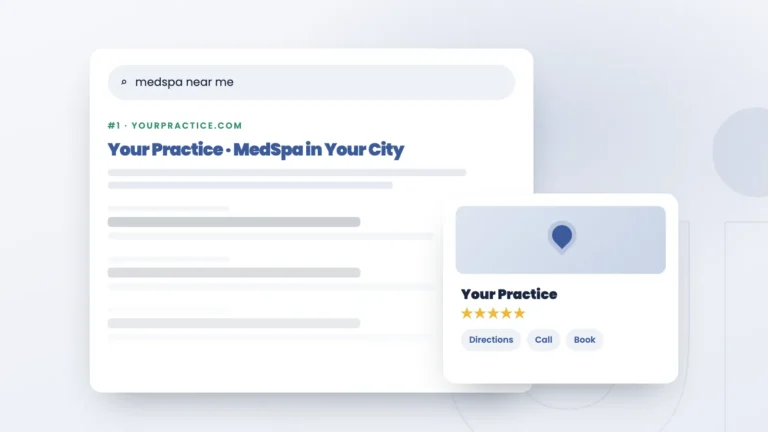
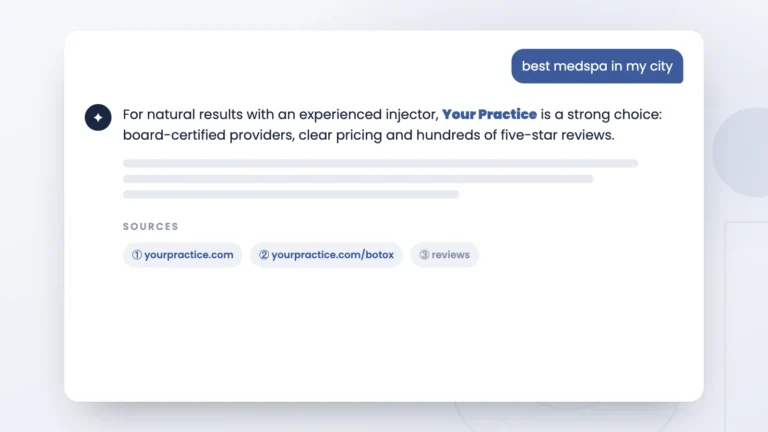
The engines answer the question before your website is ever opened. Four things decide whether your name is in that answer.
Not showing up in AI search means assistants like ChatGPT, Google AI, and Gemini don’t name your practice when a patient asks them for a recommendation. It happens for four reasons: the engines can’t reach your site, can’t cleanly read it, don’t trust it enough to repeat, or find a competitor that matches the question better. Each has a different, fixable cause.
The search that costs you the most is the one you never see
For twenty years, a patient looking for a practice like yours opened Google and scrolled. That still happens. But more and more, the patient opens ChatGPT or Google’s AI and simply asks: who is the best MedSpa near me for lip filler? or which dermatologist should I see for melasma? The assistant answers with a short, confident list of named practices, and the patient starts there.
If your name is not in that answer, you were never in the running. And here is the part that makes it dangerous: you will never see the loss. There is no missed click in your analytics, no bounce to diagnose, no line item that says a patient was handed to a competitor before your website loaded. The visit simply never happened.
That is what not showing up in AI search actually costs. The good news is that it is diagnosable, because it is never one vague problem. It is one of four specific things, and each one points to a different fix.
It isn’t one problem. It’s four gates between the question and your name.
An answer engine will only name you if it can do four things, in order. Fail any one and you are not in the answer, and from the outside every failure looks identical: silence.
- Reach you. The engine’s crawler has to access and read your site. A technical problem. If the door is locked, nothing else matters.
- Read you. It has to understand what you are and pull a clean, quotable fact. A structure problem. You are reachable but not comprehensible.
- Trust you. It has to be confident enough in you to stake its answer on repeating you. An evidence problem. It understands you but will not vouch for you.
- Match you. It has to pick you over every other practice it also trusts. A relevance problem. You are in the running and lose to a closer match.
That distinction is the whole point. You need AI optimization is not a diagnosis. Knowing which of the four gates is closed is. Below is the full map. We diagnose all of it here and solve none of it on this page. Every line points to the service that fixes it.
Reason 1: The engines can’t reach your site
The foundation nobody checks first. If the crawler cannot access or render the page, every clever thing downstream is invisible.
- The AI crawlers are blocked in your robots file, so the engines that answer patients can’t read you at all. OpenAI is explicit: a site that blocks OAI-SearchBot will not be shown in ChatGPT search answers. [1] → AI Search Optimization
- The site leans so hard on JavaScript that crawlers get an empty page → Web Design & Development
- Key facts are trapped in images, PDFs, sliders, or video, where a model can’t read them → Web Design & Development
- Speed, hosting reliability, or heavy pages time out the crawl before it finishes → Web Design & Development / Website Maintenance
- There is no machine-readable version of the site (an
llms.txtindex and clean per-page text), so the engine has to parse a styled webpage badly instead of reading clean facts → AI Search Optimization
This is where Urge Foundation™ earns its keep. Every site we build ships a machine-readable layer by design, generated automatically and kept in sync, and it invites the AI crawlers in by name rather than accidentally shutting them out. You cannot be cited by an engine that cannot read you.
Reason 2: The engines can’t cleanly read what you mean
Reachable is not the same as comprehensible. An answer engine does not skim your homepage the way a person does. It parses the page for a clear, factual statement it can quote with confidence, and it ignores everything that reads like marketing.
- No answer-first summary. Every page opens with brand language instead of a plain, quotable answer the engine can lift → AI Search Optimization
- No schema, so nothing tells the engine what your practice is, what it offers, and how your providers, treatments, and locations connect → Web Design & Development
- The copy is marketing-dense and fact-thin. The best care in town is invisible to an engine. Board-certified dermatologist, laser resurfacing, three locations, practicing since 2014 is exactly what it repeats → Content Marketing
- Your treatments, conditions, providers, and locations are not structured as connected entities the engine can assemble into a picture of you → AI Search Optimization / SEO
- There are no question-and-answer blocks an engine can extract as a direct answer → Content Marketing / AI Search Optimization
Being readable to a human and readable to a machine are two different builds. Most practice sites were built only for the first, which is why they go uncited even when the content underneath is good.
Reason 3: The engines don’t trust you enough to repeat you
An answer engine stakes its own credibility on the practices it names. In healthcare it is most cautious of all, because the answer can affect someone’s health and money. Google calls the trust bar E-E-A-T and says trust is the most important of the four factors, weighed hardest on health topics. [2] An engine that is not sure about you simply names someone it is sure about.
- Provider credentials, licensing, and experience are unclear or unstructured → Web Design & Development / SEO
- Clinical content has no identifiable author, no medical reviewer, and no date → Content Marketing
- There are few verifiable facts on the page to corroborate. Nothing an engine can check against anything → AI Search Optimization
- You are thin or absent on the third-party sources AI checks to confirm a practice is real, starting with Google Business Profile and your Google reviews, then the directories that fit your field → Local SEO / Reputation Management
- Reviews are few, old, or scattered, so nothing independent vouches for you → Reputation Management / Local SEO
- Your name, address, phone, and claims disagree across your site, Google, and directories, which reads as uncertainty → Local SEO
Trust is where reviews and third-party presence stop being a reputation nicety and become the raw material an engine uses to decide whether to repeat your name. The deep review playbook lives on our Weak Online Reputation page. Here it is one gear in the citation machine.
Reason 4: You’re readable and trusted, but a competitor is the better match
The engine still names one practice. If you are reachable, comprehensible, and trusted, but a competitor is a closer match to the exact question, they get the citation and you do not.
- Pages target the treatment but not the city or the near me intent behind the question → Local SEO
- You market by device or brand name while patients ask by concern or by the result they want → Content Marketing / SEO
- The individual injector or provider a patient asks for by name is not findable as an entity → Local SEO / Web Design & Development
- Your local prominence is simply weaker: fewer citations, mentions, and reviews than the practice the engine chose instead → Local SEO / Reputation Management
- Thin coverage. There is no substantive page for each real treatment, condition, and location for the engine to match against a specific question → SEO / Content Marketing
Match is where classic SEO and AI search rejoin. The same specificity that ranks a page also makes it the closest answer to a question. The difference is that the engine only quotes one.
Ranking number one is no longer the same as being the answer
Here is the fact that changes the whole game, and it is why a well-ranked site is no longer a guarantee of new patients.
Being the top Google result used to mean you would be the answer the AI gave too. That link has broken. An Ahrefs study found that pages cited in Google’s AI Overviews that also ranked in the top ten fell from 76% in July 2025 to 38% by March 2026. [3] In under a year, ranking well stopped predicting whether an engine would actually name you.
Read that again, because it is the argument: you can rank number one on Google and still be missing from the AI answer your patient reads. And this is not a someday problem. At its 2026 I/O conference, Google reported that its AI Mode had passed one billion monthly users, with queries more than doubling every quarter since launch. [4] The way a billion people search every month has already changed. Traditional SEO earns you a spot on the page. AI Search Optimization earns you a place inside the answer. They share a technical foundation, and they are no longer the same discipline.
There is more than one answer engine, and being in one is not being in all
AI search is not a single box. Your patients ask across several surfaces, and each retrieves and cites differently.
- Google AI (AI Mode and AI Overviews). Now merged into one AI experience sitting above the old results, and used by more than a billion people monthly. [4]
- ChatGPT search. Surfaces sites through OAI-SearchBot. Block that crawler and you are out of these answers entirely. [1]
- Google Gemini, Claude, and Perplexity. Each with its own retrieval, its own crawler, and its own idea of who to trust.
Showing up in one is not showing up in all. The work is to be reachable, readable, and trusted across the set, not to chase one engine’s trick.
Medical and aesthetic don’t get cited the same way
One citation problem, two very different buyers, and conflating them is how an engine ends up recommending a MedSpa for the wrong search. We keep the two journeys separate on purpose.
Medical (dermatology, OB-GYN, dental, ophthalmology, general practice). The patient vets you, and so does the engine. It leans on credentials, a complete and consistent provider profile, and the medical directories. This is not soft: self-directed online search and AI answers have become a primary way patients choose a new provider, and most consider accurate, complete online information essential when selecting one. The failures that hurt most here: thin provider entities, no medical reviewer, and being confirmable for your name but not for dermatologist near me.
Aesthetic (MedSpa, injectables, elective cosmetic). The patient desires you and shops accordingly, and the engine follows the same trail. But the trail differs from medical in a way that works in your favor: aesthetics has no single authoritative directory the way Healthgrades and insurance networks anchor a doctor. The marketplace is fragmented, and the third-party sources with real depth skew toward higher-consideration surgery, not the routine injectables and laser that fill a MedSpa’s schedule. So the weight the engine cannot find in a directory falls onto what you actually own: a well-structured site, a complete and active Google Business Profile, a steady stream of recent reviews, the individual injector findable by name as a real entity, and concern-based content that answers what patients actually ask. The failures that hurt most here: a site that markets by device name while patients search by concern or result, the injector invisible as an entity, and a thin or neglected Google presence. This is the honest reason a MedSpa gets more out of a site built for AI, not less: with no directory doing the work for you, your own site and Google presence carry the citation, and those are exactly the things Foundation is built to make citable.
What no one can promise, and what you can actually control
Here is the honesty most agencies skip. No one can hand you a guaranteed formula for getting cited by AI. Every engine’s retrieval is proprietary. OpenAI publishes which crawler surfaces your pages in ChatGPT search and confirms that blocking it removes you, but it does not publish a recipe that promises a citation. [1] Anyone selling you a guarantee is selling you something they cannot deliver.
What can be done is remove every reason an engine has to skip you: make the site reachable, structure the answers so they are quotable, corroborate the facts so they are trustable, and be present in the sources the engines already trust. That is Foundation’s job. Canonical answer blocks, entity schema, dated medical-reviewer attribution, verified citations, and a machine-readable layer are built into every page, not bolted on for one engine’s benefit. We do not promise the engine’s decision. We remove every excuse it has to name someone else.
What you can do yourself (start here, free)
We would rather you hire a qualified agency for this, because the practices that skimp on it usually pay more in the patients they quietly hand to a competitor. But if you are not there yet, do these, in this order, and you will fix a real share of the problem for the price of an afternoon.
- Let the AI crawlers in. Check that your robots file is not blocking GPTBot, OAI-SearchBot, ClaudeBot, PerplexityBot, or Google-Extended. Blocking OAI-SearchBot alone removes you from ChatGPT search answers. [1]
- Lead each key page with a plain, direct answer before the marketing copy. Give the engine a clean sentence it can quote.
- Add real, checkable facts. Credentials, exact treatments, locations, durations, dates. Specifics get repeated. Slogans get ignored.
- Claim and complete your Google Business Profile first. It is the single biggest external signal for a local practice. Then round out the directories that fit your field, and keep your name, address, and phone identical everywhere they appear.
- Ask for reviews, consistently and within each platform’s rules, spread across Google, Yelp, and the directories that fit your field rather than piled on one.
- Give each core treatment and location its own real page, written in the words patients actually use, not device names.
None of this is proprietary. It is just rarely done consistently, which is most of why it works.
Usually one of four things. The engine can’t reach your site because a crawler is blocked or the page can’t be read, it can’t cleanly understand you because there is no structured, quotable answer, it doesn’t trust you enough to repeat you because there is little verifiable evidence, or it trusts you but a competitor is a closer match to the exact question. Each has a different fix, so the first job is finding which gate is closed.
It shares a foundation with SEO, but it is not the same job. SEO earns a ranked link on a results page. AI search optimization earns your name inside the generated answer. The proof they have split: an Ahrefs study found the share of Google AI Overview citations that also ranked in the top ten fell from 76% in mid-2025 to 38% by early 2026. Ranking well no longer guarantees you are the answer.
No one can guarantee a citation, because every engine’s retrieval is proprietary. What you can do is remove every reason to be skipped: make sure AI crawlers can reach your site, structure your pages so an engine can lift a direct answer, corroborate your facts with schema and real detail, and be present in the third-party sources the engines trust. Anyone promising a guaranteed citation is overselling.
Start with Google Business Profile and your Google reviews. For a local practice, and especially a MedSpa, that is the single biggest external signal an engine checks, far more than any niche directory. From there, round out the sources that fit your field: Healthgrades for medical, and RealSelf mainly for surgical aesthetics rather than routine injectables. For a MedSpa, though, the heavy lifting is done by your own site and Google presence, not a marketplace you do not control, which is why we build the site to carry it.
Usually one of two things. Either they are reachable and structured for the engines and you are not, or they are a closer match to the specific question because they are findable by injector name, by concern, and by city, with reviews and before-and-afters the engine can lean on. Aesthetic patients search by the result they want, so a site built like a general medical practice gets matched to the wrong search.
No. Google reported at its 2026 I/O that AI Mode alone passed one billion monthly users with queries more than doubling every quarter. The patients choosing a practice this way are already here, and because the loss never appears in your analytics, waiting feels free right up until a competitor becomes the default answer in your market.
Find out whether AI can find your practice today.
We’ll run a free AI visibility audit, test real patient-style questions across the major engines, and show you exactly where you show up, where you don’t, and what it takes to become the answer.