It usually isn’t one problem. It’s four, and they have four different fixes.
“Can’t be found online” is really four separate problems. Search engines can’t crawl or index your site. They index it but don’t find it relevant. You’re relevant but lack the local prominence to rank. Or you rank, and patients still pick a competitor. Each has a different fix. Knowing which one you have is the whole difference between wasted spend and a full schedule.
It doesn’t mean one thing. It means four.
Almost every practice that says “we can’t be found online” has already decided the fix is SEO. Sometimes it is. Often it isn’t, and buying more of the wrong thing is why the last agency didn’t move the needle.
Google describes its own job in three steps: crawl, index, serve. [1] A practice can fail at any one of them, and the failure looks identical from the outside, you’re just not there. So before anyone sells you a solution, the honest question is which of four things is actually happening:
- Search engines can’t access or understand you. A technical problem. You’re invisible because the door is locked.
- They can, but you’re not relevant. A content problem. You’re in the index, but nothing on your site matches what patients actually type.
- You’re relevant, but not prominent enough locally. A trust-and-authority problem. You match, but three competitors match harder.
- You show up, and patients still don’t choose you. A proof problem. You ranked and lost the click anyway.
That distinction is the point. It’s the difference between “you need SEO” and a diagnosis. It also happens to be why the fix pulls from web strategy, technical SEO, local SEO, content, reputation, and AI-search visibility rather than one lever. Below is the full map. We diagnose all of it here and solve none of it on this page, every line points to the service that fixes it.
Reason 1: Search engines can’t access or understand you
The foundation nobody checks first. If crawlers can’t reach or render the page, nothing downstream matters.
- Important pages aren’t indexed, or an old redesign left
noindextags and crawler blocks behind → Website Maintenance - The XML sitemap is missing, stale, or lists the wrong pages → Website Maintenance
- The site leans so hard on JavaScript that crawlers can’t read it → Web Design & Development
- Speed, mobile usability, or hosting reliability get in the way of the crawl → Web Design & Development
- Structured data is missing, wrong, or contradicts the visible page → Web Design & Development (Foundation)
- Treatments, providers, and locations are buried four clicks deep → Web Design & Development
- Two pages fight over the same search, so Google can’t decide which to rank → SEO
- AI search crawlers like OpenAI’s OAI-SearchBot are blocked, so you can’t appear in ChatGPT answers at all → AI Search Optimization
This is the “not just off-page SEO” layer, and it’s where Urge Foundation™ earns its keep. Every site we build is engineered to be crawled and understood from the first byte: clean architecture, correct schema, machine-readable structure, no JavaScript walls. You can’t optimize your way out of a site that search engines can’t read.
Reason 2: You don’t match what patients actually search
The biggest content gap, and the most common. You’re in the index. You’re just not relevant to a single high-intent search.
- The site speaks in brand and internal language, not patient language → Content Marketing
- Every service is crammed onto one generic “Services” page → SEO
- Individual treatments, conditions, and specialties have no substantive page of their own → SEO
- Pages target the service but not the city where it’s offered → Local SEO
- Titles and headings are clever or vague instead of describing the thing → SEO
- Keyword research happened after the site was written, if at all → SEO
- You have content for what you want to sell, not for the problems patients are trying to solve → Content Marketing
- Nothing connects conditions, treatments, providers, results, and locations to each other → SEO / Web Design & Development
Being online is not the same as being relevant to a search. A brochure site that reads beautifully and answers no real question is invisible for every search that matters.
Reason 3: Your local presence is weak or fragmented
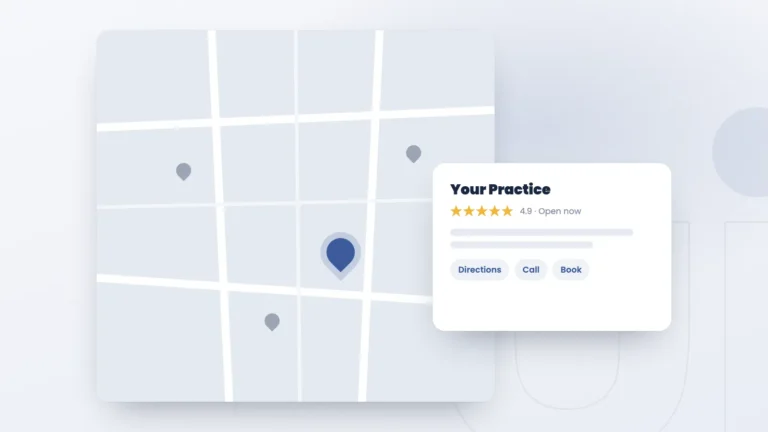
Google says local results run on three things: relevance, distance, and prominence. [2] Distance you can’t optimize away. Relevance and prominence you can, and this is where most practices are quietly losing.
- The Google Business Profile is incomplete, unverified, suspended, or neglected → Local SEO
- The primary category is wrong, or you’ve loaded up secondary categories that dilute the signal → Local SEO
- Name, address, phone, or hours vary across the web → Local SEO
- Duplicate listings split your authority and contradict each other → Local SEO
- There’s no strong page for each real physical location → Local SEO / Web Design & Development
- Multi-location pages are near-identical with only the city swapped → Local SEO
- You’re trying to rank in cities where you have no real presence → Local SEO
- Practitioner listings compete with the practice’s own listing → Local SEO
- Few local links, citations, or mentions, and few, old, or scattered reviews → Local SEO / Reputation Management
- Or the honest one: your local competitors are simply stronger and more established → the whole system
Prominence is where reviews stop being a nicety and become a ranking signal. Google names reviews and mentions as part of how prominent, and therefore how findable, you are. [2]
Reason 4: Search engines and AI don’t see enough evidence to trust you
This one is sharper in healthcare, because the content can affect someone’s health and money. Google calls it E-E-A-T, experience, expertise, authoritativeness, trust, and says trust is the most important of the four. [3] Health content is exactly where that bar is highest.
- Provider credentials, licensing, and experience are unclear → Web Design & Development (provider schema) / SEO
- Clinical content has no identifiable author or medical reviewer → Web Design & Development (Foundation) / Content Marketing
- Treatment content is generic enough to belong to any competitor → Content Marketing
- Articles never show when they were published, reviewed, or updated → Content Marketing
- Claims differ between your site, your Google profile, directories, and social → Local SEO / Reputation Management
- The business has little independent recognition anywhere else online → Reputation Management / SEO
- The site is padded with thin, near-duplicate, or mass-produced pages → SEO
That last one matters more than it used to. Google’s own policy is blunt: generating many pages to manipulate rankings is scaled content abuse, and “more content” produced for search engines instead of people can lower you, not raise you. [4] The fix is never volume. It’s evidence.
Reason 5: AI can’t confidently identify or recommend you
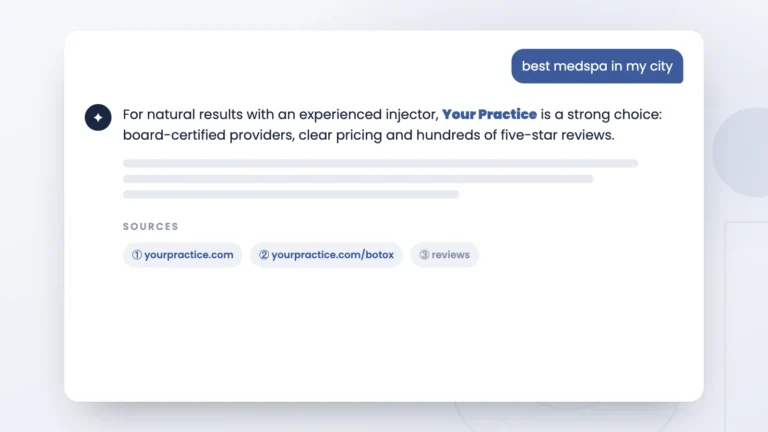
Not a fifth silo. It’s the first four, seen through an AI’s eyes. An answer engine still needs to access you (Reason 1), find you relevant (Reason 2), see you as prominent (Reason 3), and trust you (Reason 4), it just has less patience and no results page to scroll.
Press Ganey’s consumer research found that for the first time, online search has passed provider referrals as the way patients choose a new provider, and nearly one in five have already used AI tools to find one. [5] So this is not a someday problem.
- Copy isn’t structured for extraction: no direct answers, no clean question-and-answer blocks an AI can lift → AI Search Optimization
- No entity or corroboration schema, so nothing ties your brand, providers, services, and locations together as one thing → AI Search Optimization (Foundation)
- Marketing-heavy copy with almost no verifiable facts to cite → AI Search Optimization
- Key information trapped in images, PDFs, sliders, or video where a model can’t read it → Web Design & Development
- You’re absent from the third-party sources AI leans on, Healthgrades, Yelp, RealSelf → Reputation Management / Local SEO
- The relevant AI crawlers can’t reach the content in the first place → AI Search Optimization
Here’s the honesty most agencies skip: no one can hand you a guaranteed formula for getting cited by AI. OpenAI publishes which crawler surfaces your pages in ChatGPT search, and confirms that blocking it removes you from those answers, but it does not publish a recipe that promises a citation. [6] Every engine’s retrieval is proprietary. What we can do is remove every reason an AI has to skip you: make the site readable, structure the answers, corroborate the facts, and be present in the sources AI already trusts. That’s Foundation’s job, llms.txt, canonical answer blocks, entity schema, all built in.
Medical and aesthetic don’t get found the same way
One findability system, two very different buyers. We keep the research separate on purpose, because conflating them is how a MedSpa ends up marketed like a dermatology practice.
Medical (dermatology, OB-GYN, dental, ophthalmology, general practice). The patient vets you. Credentials, insurance, proximity, and a complete, trustworthy provider profile decide it. Press Ganey found the completeness of a provider’s online profile is now the single biggest driver of the decision to book. [5] The failures that hurt most here: missing condition and symptom pages, thin provider bios, no medical reviewer, and being visible for your name but absent from “dermatologist near me.”
Aesthetic (MedSpa, injectables, elective cosmetic). The patient desires you, and shops accordingly. The aesthetic buyer often starts on RealSelf, the category’s own marketplace, before Google, especially for bigger procedures, and vets by the specific injector’s name, by before-and-after photos, and by detailed reviews that describe the actual experience. [7] The failures that hurt most here: no RealSelf presence, the individual injector not findable by name, no before-and-afters, a site that markets by device name while patients search by concern or result, and Instagram carrying the whole conversation while the website stays thin.
Both still have to be found first, across the same three surfaces, the map pack, organic, and AI answers. The difference is what turns the found visitor into a booked patient, and we build for the right one.
Reviews are a findability signal, not just a trust signal
Worth saying plainly because most practices file reviews under “reputation” and stop there. Reviews are also how you rank: Google names them as part of local prominence [2], and AI answer engines lean on the third-party review sources where your patients already are. For aesthetics, reviews aren’t a supporting signal at all, they’re where the buyer starts. [7]
The operational fix is unglamorous and it works: ask every satisfied patient, consistently, within the platforms’ own rules, and spread the reviews across Google, Yelp, and RealSelf instead of piling them on one. The full reputation playbook, cadence, responses, surfacing real patient voices, lives on our Weak Online Reputation page and in Reputation Management. Here it’s one gear in the findability machine.
What you can do yourself (start here, free)
We’d rather you hire a qualified agency, honestly, the practices that skimp on marketing usually pay more in the patients they hand to a competitor. But if you’re not there yet, do these, in this order, and you’ll fix a real share of the problem for the price of an afternoon:
- Claim and verify your Google Business Profile. Free, and it’s the single biggest lever for “near me.” Set the correct primary category, and don’t drown it in secondary ones.
- Fix your NAP. Make your name, address, and phone identical everywhere they appear, your site, Google, Yelp, every directory. Inconsistency quietly costs you rankings.
- Fill the profile out completely. Services, hours, appointment link, a real description, and recent photos. Google rewards complete over empty.
- Ask for reviews, the right way. Ask every happy patient, follow Google’s and each platform’s rules (no gating, no incentives), and respond to the ones you get.
- Give each core treatment and location its own real page, written in the words patients actually search, not device names, not “look and feel your best.”
- Check that you’re crawlable. Make sure important pages aren’t set to
noindexand that AI crawlers like OAI-SearchBot aren’t blocked in your robots file, or you can’t appear in ChatGPT search at all. [6]
None of this is proprietary. It’s just rarely done consistently, which is most of why it works.
Frequently asked questions
Usually one of four things: search engines can’t crawl or index your site, they index it but don’t find it relevant to the search, you’re relevant but not prominent enough locally to rank, or you rank and patients choose a competitor anyway. Each has a different fix, so the first job is figuring out which one you have.
SEO is part of it, but “you need SEO” is the lazy answer. Being invisible can be a technical crawl problem, a content-relevance problem, a local-prominence problem, or a trust and proof problem. Only one of those is fixed by classic SEO. Buying more of the wrong lever is why the last effort didn’t work.
First, make sure AI crawlers like OpenAI’s OAI-SearchBot can actually reach your site, blocking them removes you from ChatGPT search entirely. Then structure your content so an AI can lift a direct answer, tie your brand, providers, and services together with schema, and be present in the third-party sources AI trusts. No one can promise a citation, retrieval is proprietary, but you can remove every reason to be skipped.
No, and it can hurt. Google’s spam policy treats mass-produced pages made to manipulate rankings as scaled content abuse, whether a human or AI writes them. What ranks is evidence: real, specific, useful pages that answer a real question, not volume.
Partly. The technical and local foundations are the same. But aesthetic patients find you differently, they often start on RealSelf, vet by the injector’s name and before-and-after photos, and search by the result they want rather than the device. If your marketing treats a MedSpa like a medical practice, you’ll be optimized for the wrong search.
Find out which of the four is costing you patients.
We’ll run a free visibility audit, map pack, organic, and AI answers, and tell you exactly where you’re losing the search and what it’s worth to fix it.