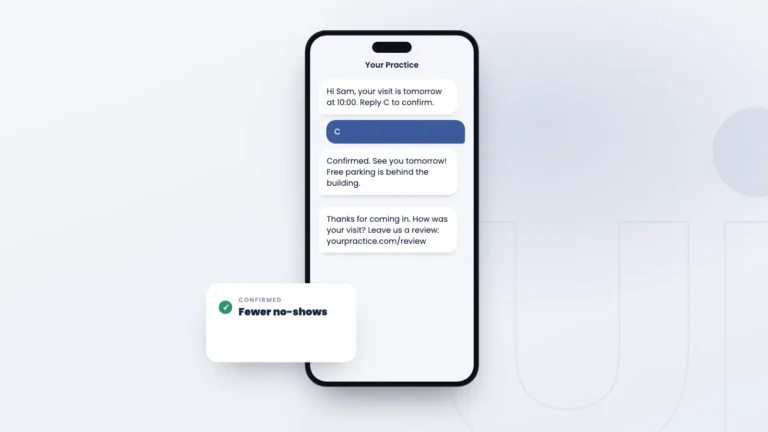
Appointment reminders reliably reduce no-shows, and a text is the one reminder patients actually read. The five templates below are written to do three things: confirm the appointment, make rescheduling a one-tap reply, and stay HIPAA-aware by never naming a treatment or confirming a condition. Adapt the placeholders, keep the tone warm, and send them on a simple cadence.
Do reminder texts really reduce no-shows?
Yes. A systematic review and meta-analysis of appointment reminders found that patients who received a reminder were on average about 11% more likely to attend than those who did not. [1] And reminders that also make the cost of a missed slot visible reduce no-shows further: two randomized trials cut the no-show rate from 11.1% to 8.4% just by stating the cost. [2] A text works because it is read almost immediately, where a mailed card or an email is often ignored.
One rule before the templates: keep protected health information out of every message. Do not name the treatment, the condition, or anything clinical. A reminder should confirm a time, not a diagnosis, and every text should include a simple opt-out.
The 5 templates
Replace the bracketed placeholders with your details. Keep them short; a text that scrolls is a text that gets skipped.
1. The confirmation (send when the appointment is booked)
Hi [First Name], you’re booked with [Practice] on [Day, Date] at [Time]. Reply C to confirm or R to reschedule. Questions? Call us at [Phone]. Reply STOP to opt out.
Why it works: it turns a booking into a two-way commitment on day one, and gives the patient an easy path to reschedule instead of quietly ghosting later.
2. The two-day reminder (48 to 72 hours before)
Hi [First Name], a friendly reminder of your visit to [Practice] on [Day] at [Time]. Reply C to confirm or R if you need a new time. See you soon.
Why it works: far enough out that a patient with a conflict can still move it, close enough that it is top of mind. The reply option catches the wobble before it becomes a no-show.
3. The value nudge (24 hours before)
Hi [First Name], we’re looking forward to seeing you tomorrow at [Time]. Your time is reserved just for you, so if anything’s changed, reply R and we’ll find a new slot. Reply C to confirm.
Why it works: it makes the reserved slot feel real and personal without stating a fee, which is the gentle version of the effect that cut no-shows in the trials. [2] It reads as care, not a warning.
4. The day-of reminder (2 to 3 hours before)
Hi [First Name], see you today at [Time] at [Practice], [Address]. Need directions or running late? Just reply here.
Why it works: the last-mile nudge. It removes the two most common day-of drop-off reasons, forgetting and friction, by putting the time, place, and a reply option in one glance.
5. The reschedule and win-back (after a missed appointment)
Hi [First Name], we missed you today and hope everything’s okay. We’d love to get you back on the calendar, reply R or call [Phone] and we’ll find a time that works.
Why it works: a no-show is not a lost patient unless you treat it like one. A prompt, warm, blame-free message rebooks a meaningful share of missed appointments, which is far cheaper than replacing the visit with a new patient.
How should I send these, all at once or spaced out?
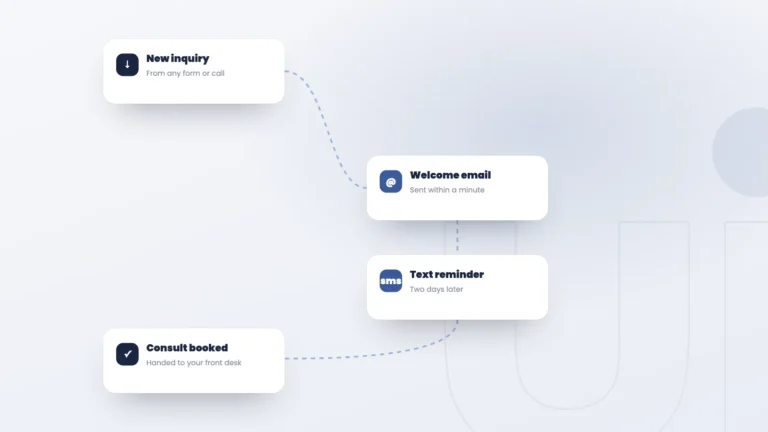
Space them, and automate them. One reminder helps; a small sequence, confirmation, a two-day, a day-of, catches different patients at different failure points. The key is that it runs automatically, because a busy front desk cannot reliably send perfectly timed texts to every patient by hand. Make at least one message two-way so patients can reschedule with a reply, and keep the reschedule link one tap. The deep diagnosis behind the empty chair lives on our Too Many No-Shows page; the system that runs these is Text Marketing with Marketing Automation.
The bottom line
You do not need clever copy to cut no-shows. You need reminders that arrive, on a channel patients read, with an easy way to confirm or move the appointment, and no clinical detail that could cross a HIPAA line. Set these five on a simple automated cadence and the empty chairs start filling back in.
Yes. A systematic review and meta-analysis found patients who received a reminder were about 11% more likely to attend, and two randomized trials cut the no-show rate from 11.1% to 8.4% just by stating the cost of a missed slot. A text works because it is read almost immediately, where a mailed card or an email is often ignored.
A small automated sequence beats a single reminder: a confirmation when the appointment is booked, a two-day reminder, and a day-of nudge catch different patients at different failure points. Make at least one of them two-way so a patient can reschedule with a reply instead of a phone call, and let it run automatically rather than by hand.
Never name the treatment, the condition, or anything clinical. A reminder should confirm a time, not a diagnosis. Keep protected health information out of every message, and include a simple opt-out on the message that initiates contact.
Send a prompt, warm, blame-free message that makes rebooking easy, something like we missed you and would love to get you back on the calendar, reply R or call us. A no-show is not a lost patient unless you treat it like one, and recovering a missed visit is far cheaper than acquiring a new patient to replace it.
Want these running automatically?
We’ll set up your reminders, two-way confirmations, and win-back texts, built with HIPAA in mind, so they send on their own and your schedule stays full.